

Event Recap
At 7:37:43 Philippines local time on June 8, 2026, a powerful magnitude 8.2 earthquake struck off the coast of Mindanao, Philippines (5.7° N, 125.2° E), at a depth of 39 miles (63 km), according to the U.S. Tsunami Warning Centers. This major seismic event prompted tsunami advisories across Japan’s Pacific coast and triggered immediate coastal warnings.
Tsunami waves have already been observed across the region, including heights of 0.83 meters at Sangihe Island (Indonesia) and 0.46 meters in Davao (Philippines) (PTWC data compiled by Weathernews (1), as of June 8, 2026, 11:48 Japan local time). In Japan, tsunamis of up to 0.3 meters were recorded in areas like Miyazaki port later in the afternoon (data compiled by Weathernews (2), as of June 8, 2026, 16:52 Japan local time).
For maritime operators, this event serves as a timely educational reminder of how tsunamis behave and why they pose highly localized risks to shipping infrastructure.
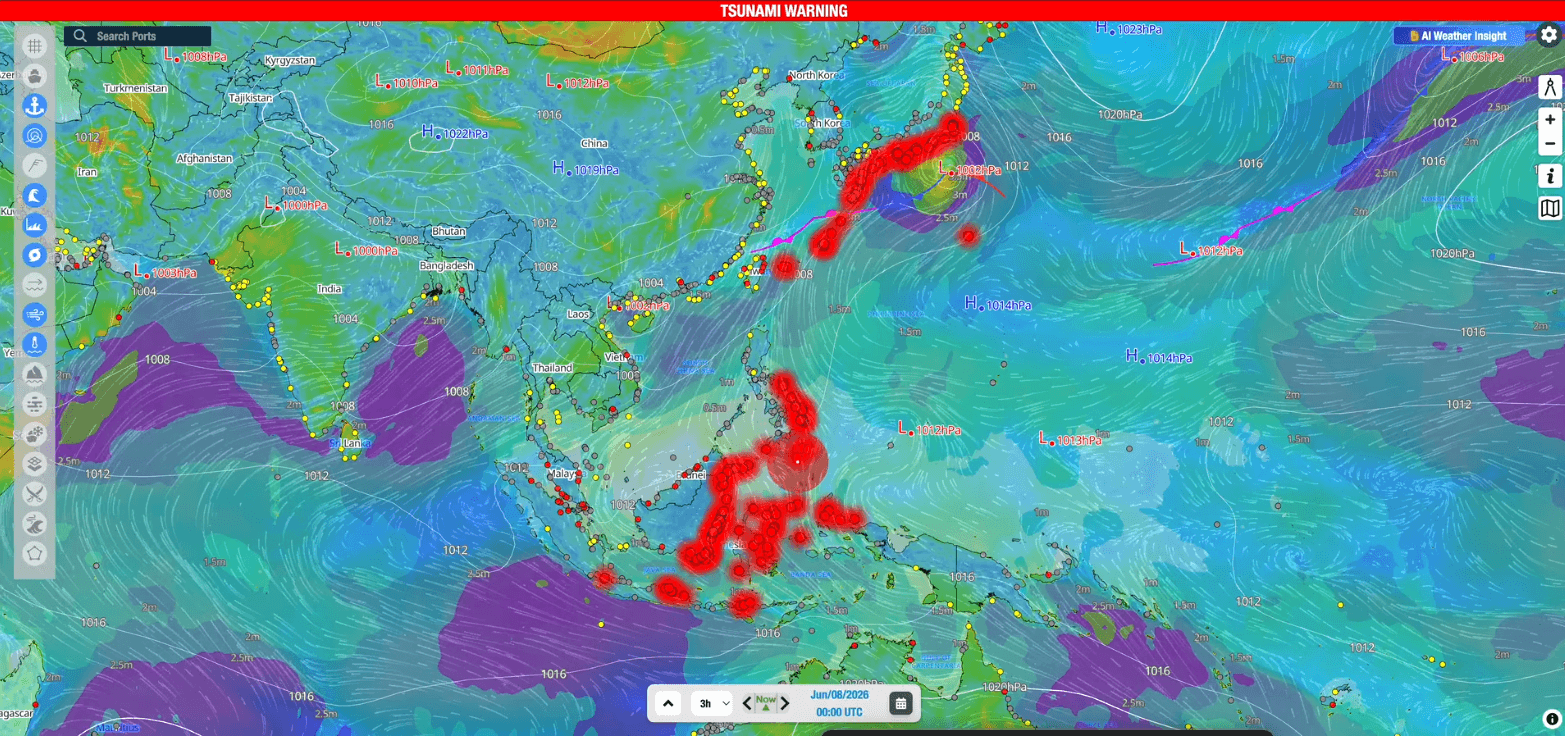
Screen capture of Weathernews SeaNavigator, valid as of June 8, 2026 00:00UTC. Real-time warning display based on the information from:
1. Japan Meteorological Agency (JMA): Japan area
Red indicates areas under a JMA Tsunami Advisory or higher (excluding slight sea-level changes).
2. Pacific Tsunami Warning Center (PTWC): Philippines and Indonesia areas
PTWC-designated ports are located within the tsunami threat area.
※Please refer to the Early Warning issued by the local authorities.
How Tsunamis Behave: Open Ocean vs. Coastlines
Tsunamis are giant, rapidly moving waves typically triggered by undersea earthquakes or volcanic eruptions. Their threat profile changes entirely based on water depth:
In the open ocean: In deep waters, tsunami waves do not dramatically increase in height. Because of this, a vessel sailing in the open ocean will most likely never even notice a tsunami passing underneath it.
Near the coast: As a tsunami travels toward land and the depth of the ocean floor decreases, the wave compresses and grows significantly in height.
Critical Hazards for Vessels
Because of this dramatic increase in wave height near the shore, ships that are located in ports, harbors, or passing through narrow straits face extreme danger if a tsunami makes a direct strike on the area.
As a standard rule of maritime safety, ships currently in port should be moved offshore to the safety of deep water—provided, of course, that there is sufficient advance warning and time to do so safely.
JMA Advisory Timeline & Maritime Impact
Following the M8.2 earthquake on June 8, the JMA promptly issued tsunami advisories at 9:05 Japan local time for extensive portions of Japan's Pacific coast. As the event played out, sea-level fluctuations were recorded along the coast, peaking at 0.3 meters in Miyazaki port. With the wave energy safely diminishing, the JMA officially lifted all maritime and coastal advisories at 16:50 Japan local time.
Key Post-Event Insights for Operators
While this specific event resulted in tsunami activity for Japan, Indonesia and the Philippines, it provides critical operational lessons for future risk management:
The Danger of Delayed Peaks: As observed during this event, it can take several hours between the initial sea-level disturbance and the arrival of the maximum wave height.
Persistent Current Disruptions: Even when wave heights appear negligible, dangerous, rapid ocean currents can persist long after the initial impact. Vessels should never return to port or approach narrow straits prematurely.
Strict Adherence to Official Clearances: Maritime operations should only resume near coastal zones after advisories are completely deactivated by local authorities, as subsequent wave cycles can occasionally strike harder than the first.
During seismic and tsunami events, adhering strictly to the official warnings and advisories issued by local authorities is of the utmost importance for vessel and crew safety. To complement these regulatory directives, we provide supplementary support and localized data tailored for the maritime shipping industry. Our services offer 24/7 monitoring to help ensure your operations remain well-informed alongside official updates. Please consult our dedicated team for additional insights regarding your specific routes and fleet management needs.