

Weathernews: Saga Welco case study
The data integrity challenge no operator can solve alone
When Saga Welco's customers began requesting granular emissions reporting, the company partnered with Weathernews to create the validated data infrastructure needed to meet those demands with confidence.
The result: a 30-40% reduction in data errors, 12 months of perfect ETA accuracy, and a single source of truth across the organisation.
The challenge: data integrity despite complete operational control
Saga Welco's partnership with Weathernews spans fifteen years. This enduring relationship reflects a fundamental truth: even the most sophisticated operators require trusted partners to solve challenges that internal capabilities alone cannot address.
The impetus for deeper collaboration emerged when Saga Welco's customers began demanding highly detailed CO2 emissions reporting. These requests went beyond regulatory minimums, requiring data granularity down to cargo metric tonne emissions per sailing distance or per delivery.
The demand was not driven by regulatory requirements but by their customers' own stakeholder reporting needs; a clear signal of where the broader industry is heading as corporate sustainability reporting becomes increasingly sophisticated.
Despite owning and controlling both vessels and crew, Saga Welco discovered discrepancies in the data flowing from their fleet. The errors ranged from simple data entry mistakes to more complex issues with measurement accuracy that no amount of internal oversight could reliably detect or prevent.
Taking a reverse innovation approach
Weathernews developed a browser-based vessel reporting system that validates data at the point of entry on board vessels. The browser-based architecture was a deliberate choice informed by Saga Welco's operational requirements. This approach eliminates the cybersecurity concerns often raised about desktop client installations, making it easier for charterers to request that vessel crews use the system without owners blocking implementation on security grounds.
The system incorporates smart logic rules that ensure parameters entered in various fields fall within logical ranges for that specific vessel type. The system will not accept an entry showing 100 metric tonnes per day fuel consumption if that vessel's average consumption over the previous 24 hours has been substantially lower. These rules catch both accidental errors and any potential attempts to misrepresent vessel performance.
The solution validates fuel consumption measurements across different fuel types, which is increasingly important as vessels use multiple fuel sources including biofuels. This granular validation enables accurate emissions calculations and compliance reporting across the full range of marine fuels now in use across the global fleet.
Weathernews provides dedicated support to help Saga Welco’s captains and masters complete reports correctly, ensuring both shipboard and shoreside elements work smoothly. The browser-based architecture enables daily updates without requiring vessel-side software installations, testing and distribution. Custom requirements can be developed and deployed within approximately one week, providing operational agility that traditional desktop software cannot match.
Measurable business outcomes
The implementation delivered quantifiable improvements across multiple operational dimensions. Saga Welco achieved a 30 to 40 per cent reduction in vessel data errors - a substantial improvement that translates directly into time savings for shore-side staff who no longer need to manually validate data. It also reduces the company’s compliance risk, and improves quality of decision-making across all departments using the data.
Since implementing the solution, Saga Welco has maintained a twelve-month record of not missing a single estimated time of arrival. This metric demonstrates that validated data translates directly into operational performance, with downstream benefits for port cost management and commercial scheduling.
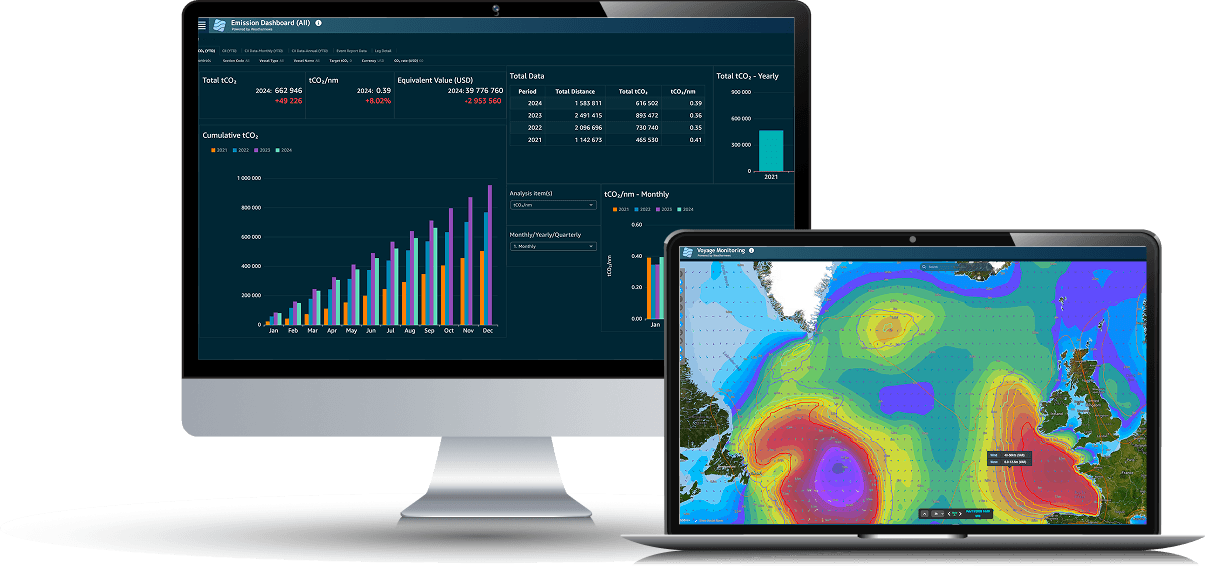
Weathernews's solution created a single source of truth that all departments can rely on. The emissions, performance, operations, finance and commercial teams now look at the same data from the same perspective, enabling more commercially correct decisions and accurate reporting across the organisation.
Beyond its internal benefits, validated data significantly streamlines the verification process with governing bodies and regulatory authorities. When emissions figures, fuel consumption records and performance metrics have already been validated at the point of entry, the documentation submitted for compliance review arrives consistent, auditable and free from the discrepancies that typically trigger queries or delays.
Rather than dedicating shore-side resources to reconciling conflicting datasets before submission, Saga Welco are able to present regulators with a single, coherent body of evidence that withstands scrutiny. This credibility extends to charter party arrangements where performance data underpins commercial agreements, ensuring that the same validated figures satisfying regulatory requirements also support the commercial relationships that depend on them.
A cycle of continuous improvement
The validated data enables Saga Welco to provide their customers with the detailed CO2 emissions reporting they demand, maintaining commercial relationships that increasingly depend on sustainability credentials.
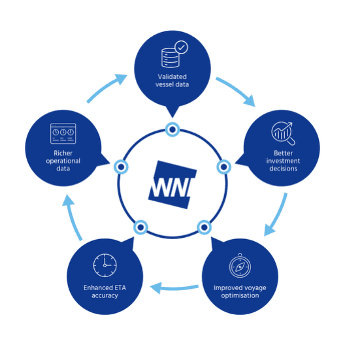
Meanwhile, validated, clean data about vessel performance creates a continuous improvement loop that compounds over time. Better data enables better decisions on clean technology investments because companies can accurately assess current performance and predict the impact of upgrades. Better investment decisions improve voyage execution and optimisation because vessels perform more efficiently and predictably. This improved optimisation generates better ETA accuracy, which in turn produces better operational data that feeds back into the cycle.