

Giant tankers forced to loiter in warm, congested waters are experiencing measurable hull fouling at an accelerated rate. The result is a compounding crisis — vessels that are slower, less maneuverable, and more fuel-hungry at precisely the moment they need to perform.
The Context: Why Ships Are Lingering
The Strait of Hormuz is the passage point for a significant share of the world's crude oil. Under normal conditions, vessels transit efficiently and on schedule. But rising tensions — including recent attacks on shipping attributed to Iran — have disrupted normal routing entirely.
Ships are now forced onto temporary, less certain routes, navigating around potential hazards such as sunken wrecks, shallow waters, and the threat of underwater mines. Many vessels are anchoring or drifting for extended periods, waiting for a safe window to pass through. This waiting period, as the data shows, is where the barnacle problem begins.
What the AIS Data Reveals
Automatic Identification System (AIS) data — which tracks vessel movements in near real-time — provides a clear picture of just how severely conditions have deteriorated. Comparing vessel traffic exiting the Persian Gulf in May-June 2025 against the same period in 2026 (AIS data source: MarineTraffic by Kpler), the speed drop is consistent across all vessel types, with tankers bearing the heaviest impact.
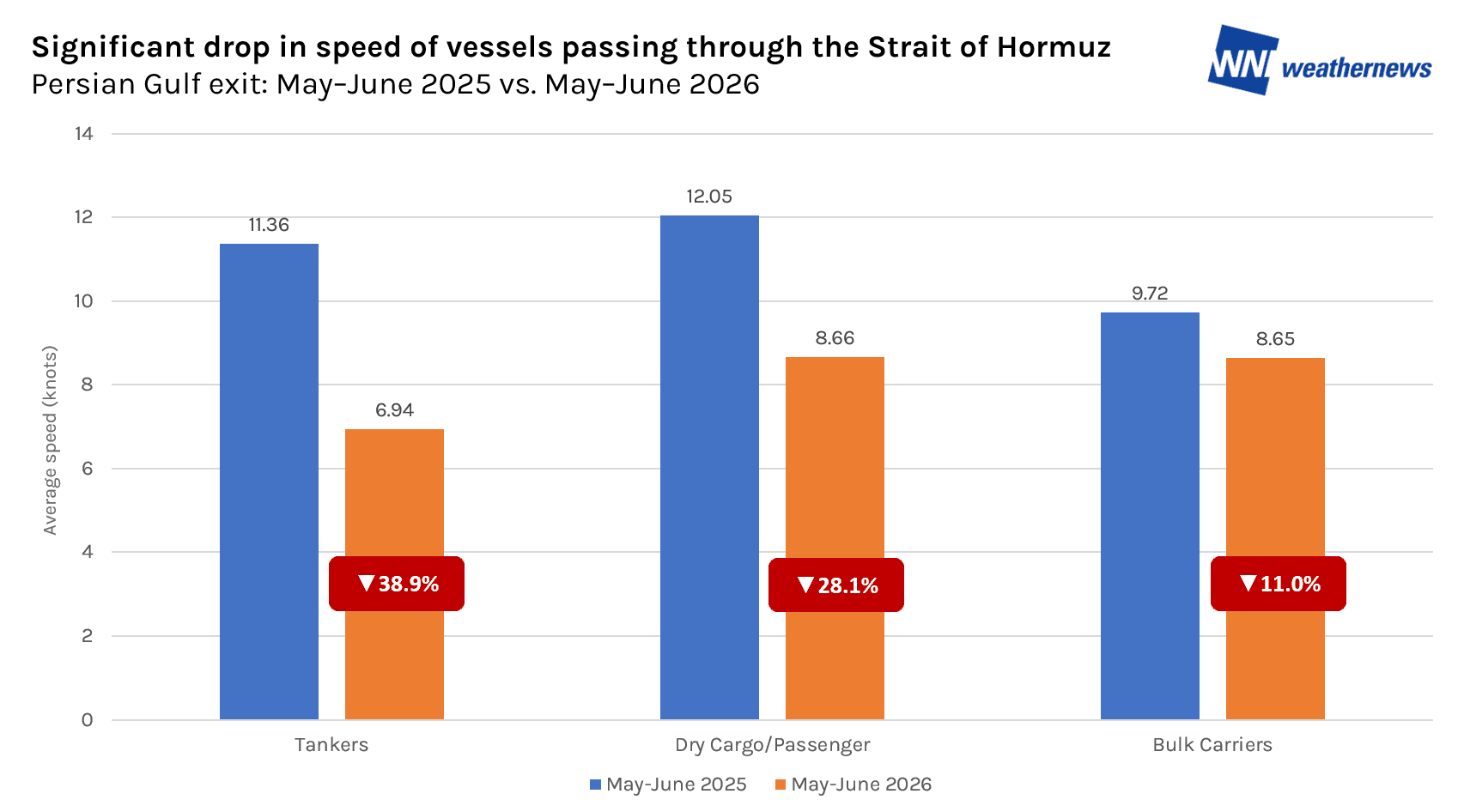
Vessel traffic also fell sharply across all categories — tankers dropped from 255 to 37 (-85%), dry cargo and passenger vessels from 308 to 80 (-74%), and bulk carriers from 221 to 31 (-86%).
Tankers are the most affected category — both in terms of speed loss and sheer reduction in traffic. This is significant because crude oil tankers represent the most economically critical segment of Hormuz traffic. Bulk carriers, by comparison, appear relatively less affected, though an 11% speed reduction is still operationally meaningful.
Tracking one specific vessel tells the story at an individual level. After being forced to drift in the strait for three months, its recorded speed dropped visibly from 11.6 knots to 9.5 knots. That may sound modest, but for a vessel of that size operating under time pressure in a high-risk zone, it represents a serious degradation in both efficiency and responsiveness.
The Science Behind the Problem
Sea surface temperatures around the Strait of Hormuz currently exceed 30°C — conditions that marine biologists would describe as near-ideal for barnacle colonization. At these temperatures, barnacle growth accelerates to several times its normal rate. Hull surfaces that might take months to foul in cooler northern waters can become heavily encrusted in weeks.
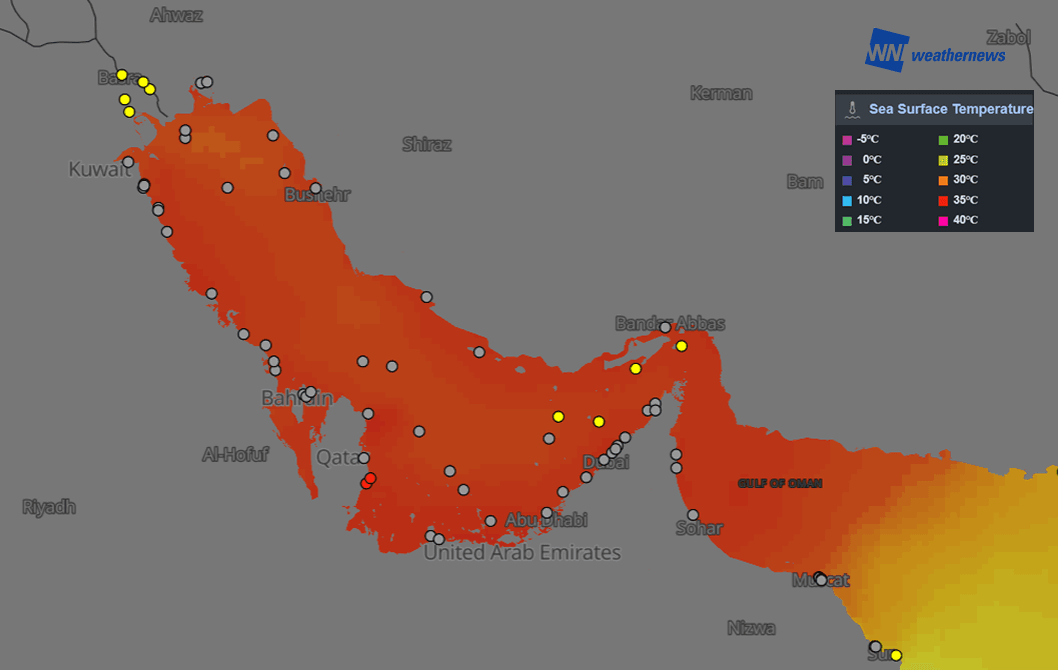
Sea surface temperature in Persian Gulf and Gulf of Oman on Weathernews SeaNavigator, as of July 10, 2026 12:00 UTC
The vicious cycle is straightforward: the more a vessel is forced to anchor or drift while waiting for a safe transit window, the more stationary it becomes, and the faster fouling accumulates. Vessels that entered the region with clean hulls are leaving — if they leave at all — with significantly compromised performance.
The consequences go well beyond losing a few knots. Barnacle encrustation affects ships in several critical ways:
- Fuel consumption can worsen by nearly 40%, according to IMO research — a substantial operational cost that shipping companies must absorb even as voyage times extend due to security detours.
- Maneuverability is reduced significantly. In a zone where an unexpected hazard — a mine, a fast-approaching vessel, a sudden course change — could demand an immediate evasive maneuver, reduced hull responsiveness is a genuine safety risk.
- Engine cooling systems draw in seawater to regulate temperature. In 30°C water, with engines already working harder to push through increased drag, the risk of overheating rises sharply. In the most serious cases, biofouling has blocked cooling intake systems entirely, causing complete engine blackout and total loss of navigation control. There are historical precedents of this leading to flooding and sinking.
Why the Obvious Solution Isn't Available
Under normal circumstances, hull fouling is a routine maintenance issue. Ships enter dry dock periodically for cleaning and recoating. Alternatively, commercial divers can be deployed to scrape fouling from a stationary vessel in port or at anchor.
Neither option is realistic here. Dry-docking requires taking a vessel entirely out of service — an expensive and time-consuming process that shipping companies are already reluctant to schedule during periods of high demand. More critically, deploying divers requires the vessel to remain stationary in open water for an extended period. In an environment where attack could come with little warning, this is not a risk any responsible shipmaster would take.
The result is that vessels continue operating with degraded hulls, absorbing higher fuel costs and accepting reduced performance as the price of staying in operation.
A Gap in Crisis Management Thinking
This situation exposes something worth examining more carefully. Maritime risk management has traditionally centered on route selection — identifying the safest corridor and navigating it accordingly. The implicit assumption is that once a safe route is chosen, the vessel itself remains fully capable of responding to whatever that route demands.
What Hormuz in 2026 demonstrates is that this assumption can break down. When vessels are forced to loiter for weeks or months in high-fouling conditions, their operational capability degrades over time. A ship that entered the region performing at full capacity may be a significantly less capable vessel by the time it needs to execute a critical maneuver.
This is a different category of risk — not external threat, but internal performance erosion caused by environmental conditions during a prolonged disruption. It is the kind of risk that does not appear on a route map or a threat assessment, but it is no less real.
For the maritime industry and international regulators, the practical implication is clear. Crisis management frameworks need to evolve to account for secondary operational risks alongside primary security threats. Hull performance monitoring, fouling-resistant coatings, and contingency protocols for vessel maintenance during extended disruptions deserve a place in the conversation.
The Downstream Effect
For those far removed from the Strait of Hormuz, the consequences are nonetheless tangible. Slower voyages mean higher freight costs. Higher freight costs flow into the price of crude oil, refined fuel, bulk commodities, and ultimately consumer goods. Countries that are heavily dependent on Middle Eastern energy imports, are particularly exposed to disruptions of this kind.
The barnacle is not a dramatic villain. But in the right conditions — warm water, a stalled vessel, a protracted crisis — it is quietly capable of bringing a giant ship to its knees, and sending ripple effects across the global economy.
The maritime industry is being asked to manage visible and invisible threats simultaneously. Getting that balance right will require thinking beyond the horizon — and beneath the waterline.