About This Outlook
As part of our ongoing commitment to supporting mariners and helping stakeholders monitor significant weather conditions, Weathernews has been providing regular port weather highlights across the Arabian Sea and Indian Ocean during the Southwest Monsoon. With the monsoon season now winding down in these regions, we are shifting our focus to the North Pacific and North Atlantic — two key regions where developing weather systems and adverse sea conditions can significantly impact maritime operations.
This week’s outlook highlights notable weather systems and areas of concern across both regions, helping ship operators and other stakeholders anticipate potential challenges to maritime operations.
North Pacific Ocean
Weathernews Maritime Forecaster comment:
As of November 16, a well-developed low-pressure system is located over the Gulf of Alaska. A large area of high waves, with significant wave heights exceeding 6 meters, has developed to the south of the system. Rough to very rough seas are expected along the U.S. East Coast through November 17.
Another area of high waves, also exceeding 6 meters, has formed between the low-pressure system and a high-pressure system to its southwest. This area of high waves will gradually move eastward.
On November 17, a cold air mass in the upper atmosphere is expected to break away from the meandering jet stream, leading to the development of a low-pressure system off the U.S. West Coast. Through around November 19, high waves are expected to occur intermittently across the North Pacific east of Japan and north of Hawaii (the northeastern Pacific).
In the Northwest Pacific, a low-pressure system southeast of the Kamchatka Peninsula will rapidly intensify as it moves into the Bering Sea. Stormy weather is expected around the system, particularly over the Bering Sea and south of the Aleutian Islands. The Bering Sea is likely to experience extremely rough seas, with wave heights exceeding 10 meters.
From November 18 to 19, low-pressure systems over the Sea of Japan and east of Japan are expected to intensify. Westerly winds will strengthen, particularly across northern Japan, raising the risk of high waves over the Sea of Japan.
Over the weekend, two low-pressure systems near the Kamchatka Peninsula are expected to merge into one. High waves may then affect a wide area of the Northwest Pacific, and caution is advised.
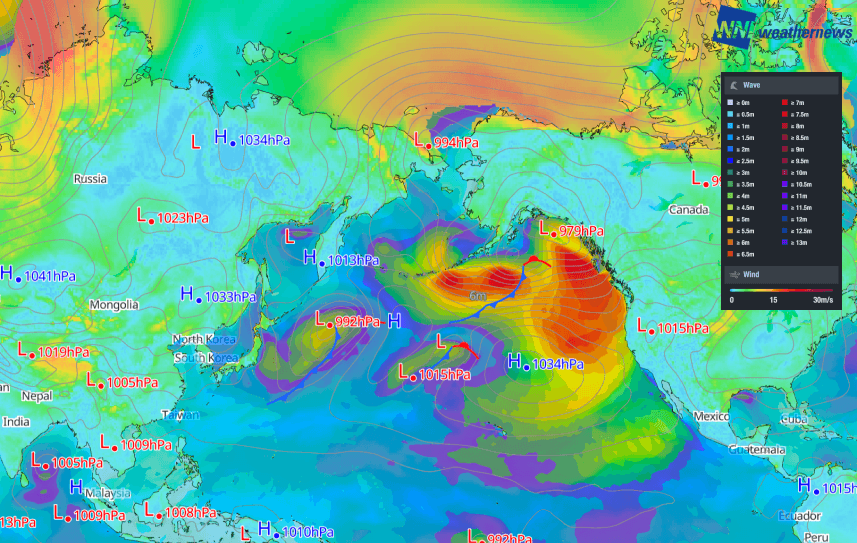
Surface pressure, wind and wave patterns over the North Pacific Ocean, valid November 16, 2026, 06:00UTC
■ Key heavy weather areas:
- Nov 16-17: Developing low-pressure system around the U.S. West Coast
- Nov 16-19: Low-pressure system accompanied by upper cold air from south of the Alaska Peninsula to offshore of the U.S. West Coast
- Nov 17-20: Rapidly intensifying low-pressure system south of the Aleutian Islands to the Bering Sea
- Nov 18-22: Developing low-pressure system around Japan to south of the Aleutian Islands
North Atlantic Ocean
Weathernews Maritime Forecaster comment:
This week, the North Atlantic will be affected by a rapidly intensifying low-pressure system over the central part of the ocean. The system will move slowly eastward, bringing widespread high waves exceeding 6 meters. Later in the week, stormy weather is expected in parts of Europe, including the Bay of Biscay.
Over the weekend, another low-pressure system is expected to develop south of Greenland. High waves are likely to affect waters east of Newfoundland, to the south of this system, and caution is advised.
There is also a possibility of a tropical depression developing near Florida later in the week. However, the risk of significant intensification is currently considered low.
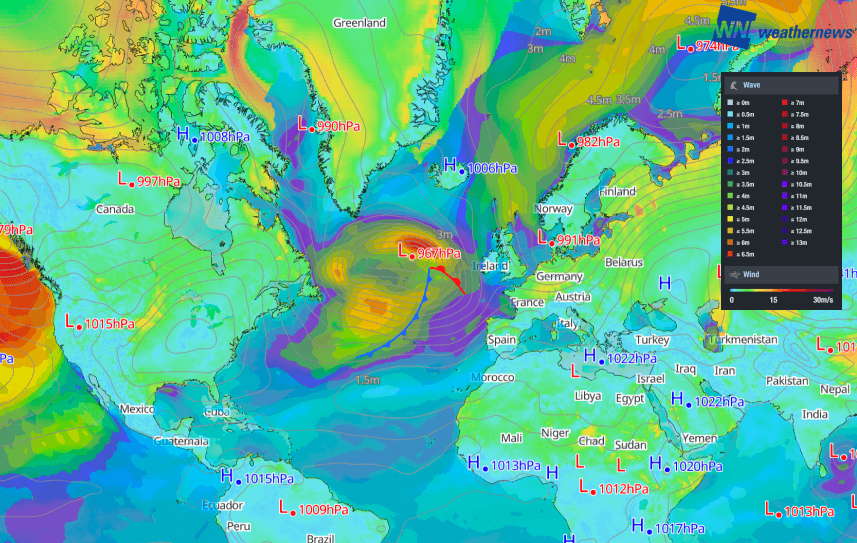
Surface pressure, wind and wave patterns over the North Atlantic Ocean, valid November 16, 2026, 06:00UTC
■ Key heavy weather areas:
- Nov 16-20: Developing low-pressure system around central North Atlantic to the Bay of Biscay
- Nov 22 onward: Developing low-pressure system around east of Newfoundland
Disclaimer: This outlook is provided for informational purposes only; our actionable, ship-specific advisories are exclusively available through our paid maritime solutions. Weathernews Inc. assumes no liability for navigational decisions, losses, or damages resulting from reliance on this general overview.