



A below-average outlook, three months running
The United States is heading toward a below-average wheat harvest this season. Weathernews' Global Crop Yield Forecast downgraded the US wheat outlook from 'Normal' to 'Below Average' in March 2026, and the assessment has held steady since.
The latest reading shows a Crop Condition Index (CCI) of 97.7. The CCI measures how a country's predicted yield compares to its own recent 5-year average, where 100 represents normal production. At 97.7, US wheat yields are expected to come in roughly 2.3% below recent norms — firmly in the 'Below Average' category (95–98). The predicted yield is 3,230 kg/ha.
The global picture: divergent outlooks across major producers
The US is not alone. Brazil's wheat forecast also sits in 'Below Average' territory at CCI 96.1, suggesting broader supply-side pressure beyond North America. China (99.1), Australia (99.4), and Germany (101.5) cluster around normal conditions. France shows a moderately positive outlook at 102.3.
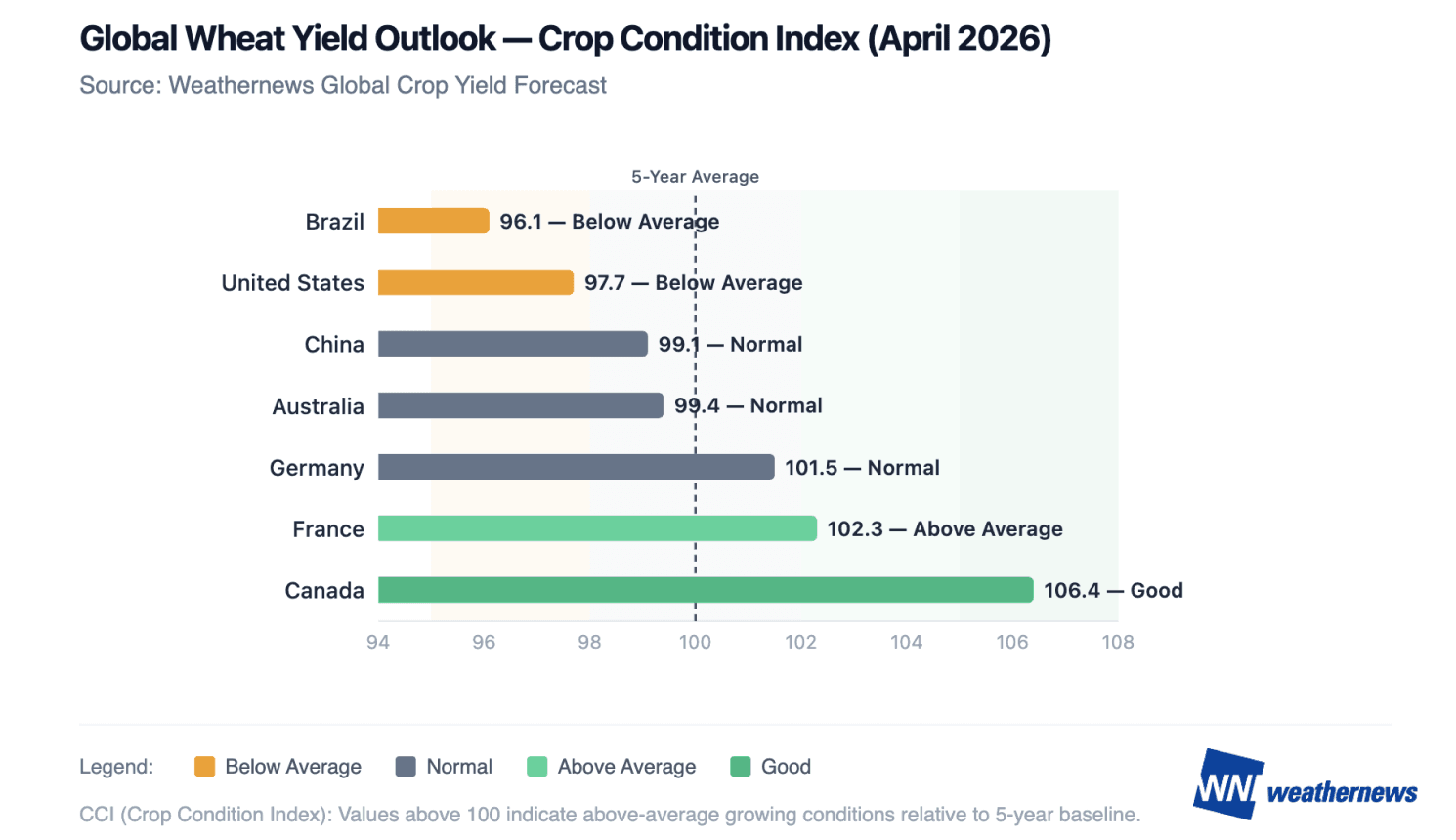
The standout is Canada, with a CCI of 106.4 — firmly in the 'Good' category and the strongest reading across all seven assessed nations.
Implications for grain shipping stakeholders
If US and Brazilian wheat exports fall short this season, importing nations may turn to alternative suppliers — most likely Canada, whose harvest outlook is strong. For bulk carrier operators, this could mean busier routes out of Canadian ports and quieter ones from the US Gulf during the peak grain shipping months.
Because the forecast is issued four months ahead of the US harvest peak in June–July, it offers an early planning signal — before shifts in cargo demand become visible in the spot market.
AIS vessel tracking data currently shows approximately 200 unique bulk carriers operating monthly in the US Gulf grain export region — home to major wheat terminals including the Port of South Louisiana and Port of Houston, which together handle a significant share of US wheat exports.
This baseline provides a reference point: changes in bulk carrier traffic through the post-harvest season (August–October) would offer tangible confirmation of how the forecasted yield shortfall translates into actual trade flow shifts.
A potential El Niño developing later this year adds further uncertainty. Past El Niño events have disrupted Southern Hemisphere harvests, raising the risk of compounding shortfalls if the Northern Hemisphere deficit isn't offset.
How the forecast works
Weathernews' Global Crop Yield Forecast uses machine learning to read early warning signals from tropical ocean climate patterns — the same mechanisms that drive El Niño — and translate them into crop yield predictions months before harvest. By monitoring these signals, the model identifies yield anomalies months before they become visible in conventional crop reporting. The forecast is updated monthly and covers the top producing nations for wheat, corn, soybeans, and rice.