

The World's Largest ECA Meets the North Atlantic's Notorious Weather
At the IMO's 84th Marine Environment Protection Committee session in May 2026, a landmark decision was adopted for global shipping. The North-East Atlantic Emission Control Area (ECA), covering the exclusive economic zones of France, Ireland, Portugal, Spain, the UK, Iceland, Greenland and the Faroe Islands became the world’s largest emission control area, setting new emissions standards for one of shipping's most commercially significant operating regions.
Once fully in force, vessels in the zone face binding limits on sulfur oxides (SOx) and fine particulate matter (PM2.5), with tighter engine-level nitrogen oxides (NOx) restrictions for ships built from January 2027. The expected payoff is substantial: The International Council on Clean Transportation (ICCT) projects SOx and PM2.5 falling by roughly 80% and 64%, and NOx by up to 71% as newer vessels phase in. Even black carbon — a priority target given its outsized warming effect on the Arctic — is set to drop by more than a third.
Yet the significance of this ECA lies not only in its scale, but in its setting: it overlays one of the most demanding weather environments in commercial shipping — where compliance and the realities of the North Atlantic now have to be managed together.
The Weather Reality Behind the New ECA Zone
The North-East Atlantic's challenging operating conditions are well documented. Significant wave heights regularly exceed 3 metres north of 48°N, while winds can generate seas above 8 metres in exposed areas.
These conditions are also becoming less predictable. Persistent marine heatwaves have kept sea temperatures across European Atlantic waters well above seasonal norms into 2026, and warmer water feeds more energy into developing storms (Copernicus Climate Change Service). For operators, that means stronger storms and conditions that are increasingly harder to anticipate across the region.
Ice conditions along the ECA's northern boundaries are just as variable. WNI's Global Ice Center data for the Greenland and Norwegian Seas shows substantial year-to-year swings in September ice extent between 2020 and 2025, despite an overall declining trend — near-minimum coverage in 2020, a partial recovery in 2021, then another sharp decline in 2023. With the ECA taking full effect in September 2028, these snapshots offer a useful benchmark for the conditions vessels may meet at the start of the compliance period.
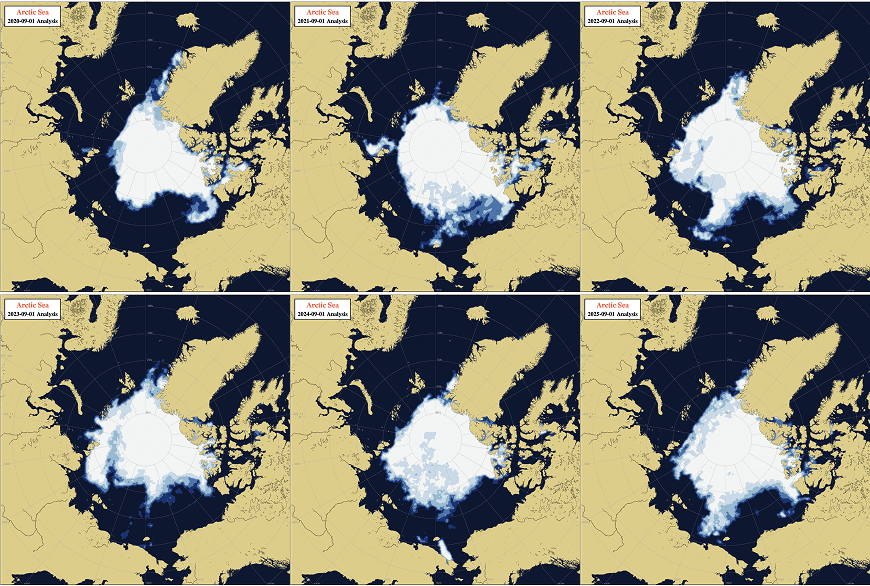
WNI’s Global Ice Center data for the Arctic Sea in September of each year from 2020-2025
For operators on northern routes, it is this inconsistency that complicates planning. Variable ice extent also affects exposure to superstructure icing — a hazard, identified by the Oil Companies International Marine Forum (OCIMF), in which wind-driven sea spray freezes on contact with the vessel, affecting deck equipment and stability. In a year when ice sits further south, these hazards move closer to standard transit routes through the northern ECA zone.
With the new regulated area joining an expanding network spanning the Baltic, North Sea, Mediterranean, Norwegian Sea and Canadian Arctic, operators will need to balance weather avoidance, fuel efficiency and schedule requirements with emissions compliance across a larger and increasingly variable operating environment.
When Weather Decisions Become Compliance Decisions
The weather and routing complexity of the North-East Atlantic ECA does not exist separately from its compliance requirements. When sea conditions force a longer route or when ice variability in the northern ECA zone requires an unplanned deviation, the additional distance and fuel consumption directly affect a vessel's CII performance and EU ETS costs. A routing change made for safety reasons can shift a vessel's annual compliance position and a fuel switch made to meet ECA sulfur standards can in turn affect GHG intensity calculations under FuelEU Maritime.
Ships transiting the zone are simultaneously subject to EU ETS, FuelEU Maritime and for UK waters, the UK Emissions Trading Scheme. The decisions required to meet one framework can have direct consequences across others: switching to lower-sulfur fuels for ECA purposes changes a vessel's carbon intensity, which affects CII ratings and FuelEU GHG intensity calculations, linking weather routing, fuel selection, and emissions reporting into a single operational chain.
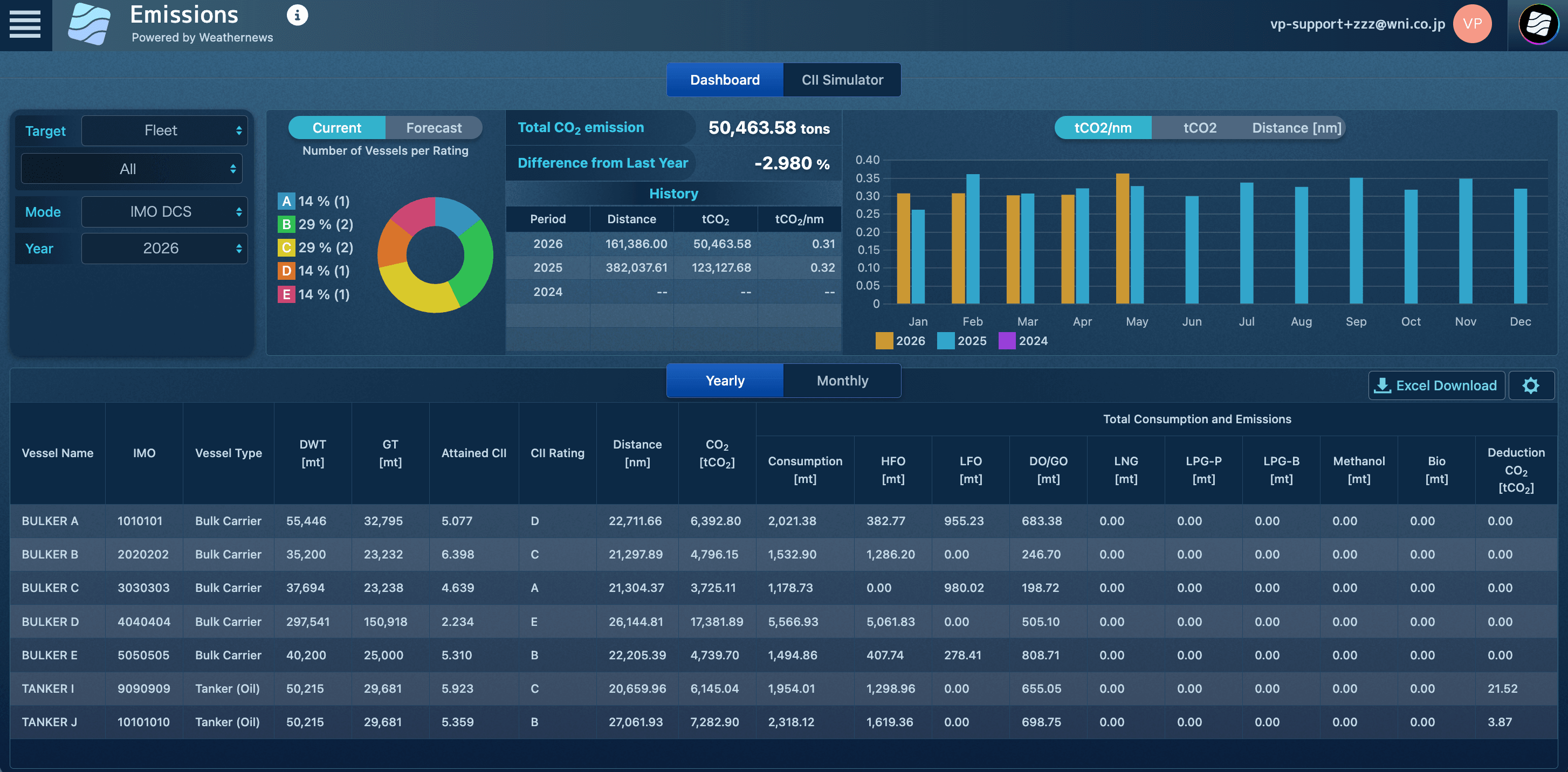
Weathernews SeaNavigator's Emissions module is built to manage exactly this overlap, tracking compliance across these frameworks in a single view. Its AI-powered Emissions Agent, launched in May 2026, takes this further — letting operators query fleet compliance directly: identifying vessels at risk of a poor CII rating, summarizing EU ETS costs by route, or explaining the calculation behind a specific FuelEU penalty.
Navigating the Atlantic has never been straightforward, and the expanding web of environmental regulations is making the journey even more challenging. With new ECA requirements adding further pressure, operators can no longer afford to react to compliance issues after they emerge. The advantage will belong to those who can anticipate regulatory and operational challenges early, assess their implications holistically, and take informed action before small issues become costly consequences.
The Arctic is warming — but that doesn't mean the ice is gone. In March 2026, sea ice in the eastern Bering Sea expanded 60% in two weeks, forcing vessels off their standard routes overnight. Read The Bering Sea Ice Anomaly of 2026: What It Means for Maritime Shipping Routes