

A Surprising Shift
When you map 2025 data from the ICC International Maritime Bureau (IMB), one waterway stands out immediately: the Singapore Strait. The scale of this concentration has drawn wide attention across the industry, including in a June 2026 analysis by Mitsui O.S.K. Lines (MOL), which highlighted it as a striking pattern in modern maritime piracy.
For an industry long accustomed — particularly through the piracy surge of the late 2000s and early 2010s — to associating piracy with the open waters off Somalia and the Gulf of Aden, this is a notable migration. The danger has moved from the vast, exposed Indian Ocean to one of the narrowest, busiest chokepoints on the planet. The question worth asking is: why there?
Not All Piracy Looks the Same
Piracy today is not a single phenomenon. The two regions that dominate the headlines behave in almost opposite ways.
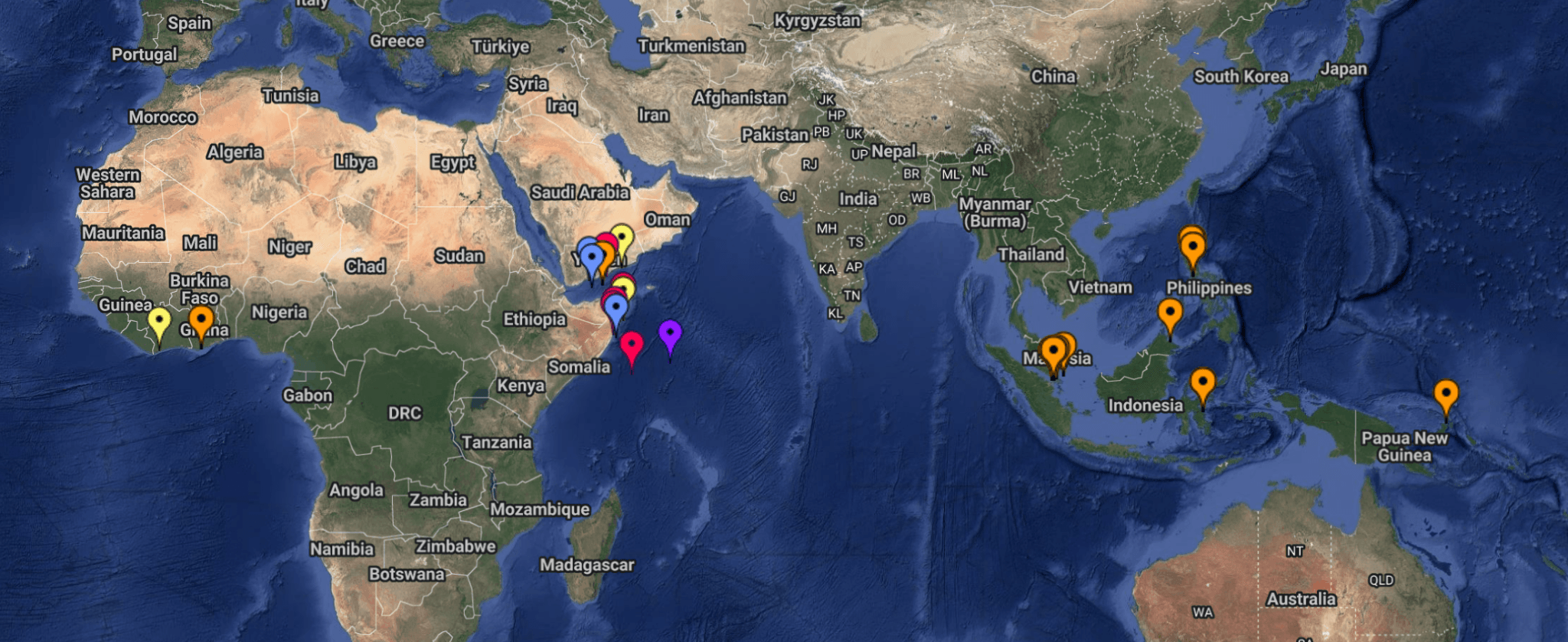
ICC International Maritime Bureau, IMB Live Piracy Map (2026).
According to the ICC International Maritime Bureau's 2025 annual report, the Singapore Strait recorded 80 incidents in 2025 — nearly double the 43 seen in 2024, and a steep climb from the mid-30s earlier in the decade. Yet almost all were low-severity: opportunistic boardings, no hijackings, no vessels fired upon, and — as The Regional Cooperation Agreement on Combating Piracy and Armed Robbery against Ships in Asia (ReCAAP) and regional authorities note — the large majority leaving crews unharmed. These are, in the strict sense, mostly armed robberies in territorial waters.
Off Somalia, the pattern is inverted. The same 2025 data records only five incidents attributed to Somali pirates — but these were far more dangerous, involving hijackings, hostage-taking and firearms on the open ocean. In other words: the Singapore Strait sees many incidents of low severity; Somali waters see few incidents of high severity. Volume has shifted east, even as the most violent piracy remains a Western Indian Ocean phenomenon.
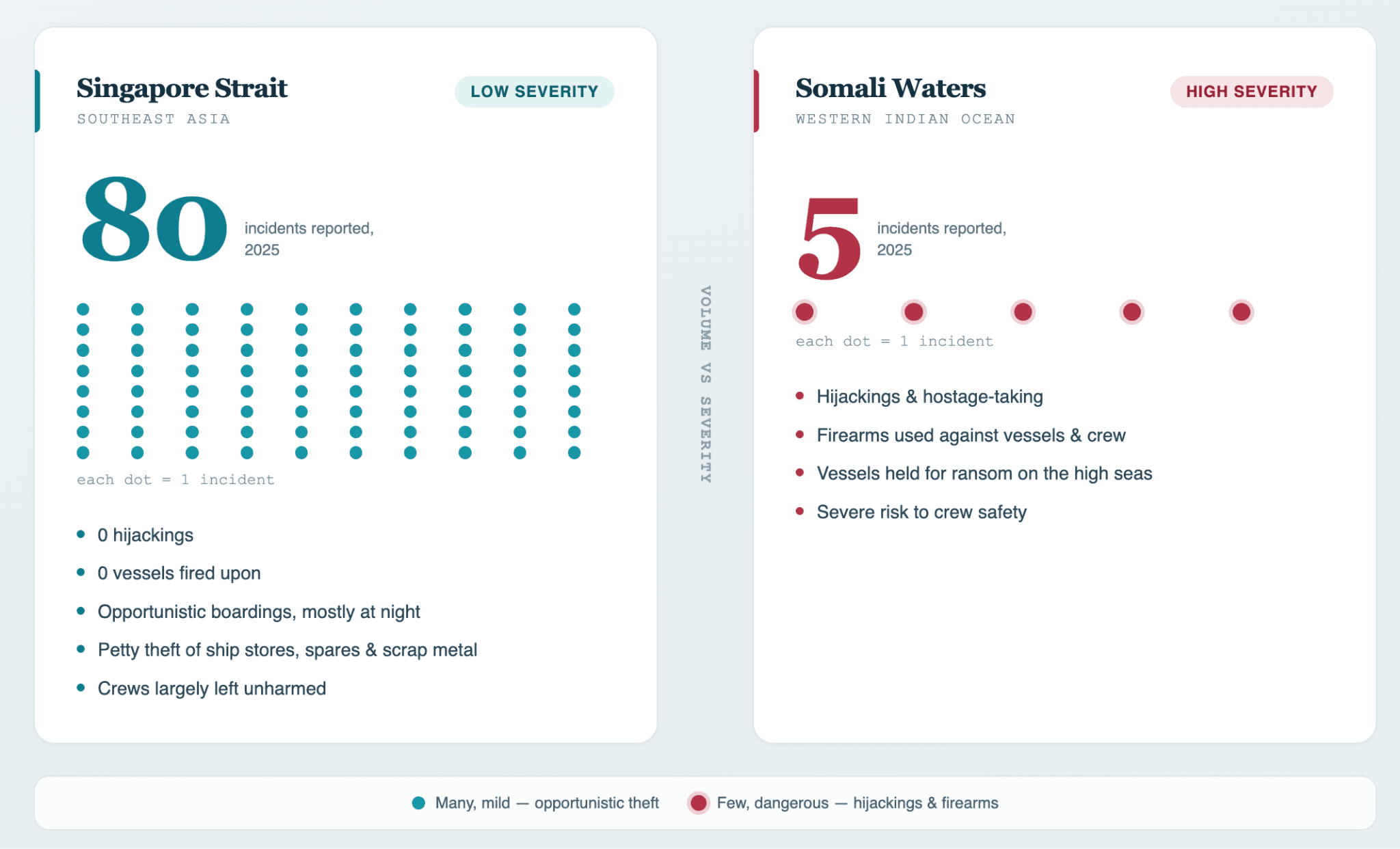
Data compiled from ICC International Maritime Bureau, Piracy and Armed Robbery Against Ships — Annual Report 2025 (Jan 2026). Volume: Table 1 (p.6); incident type: Table 2 (p.10); arms & violence: Table 6 (p.12).
Why the Shift?
No single factor explains the concentration of incidents in the Strait. Counter-piracy analysts point to several forces acting together.
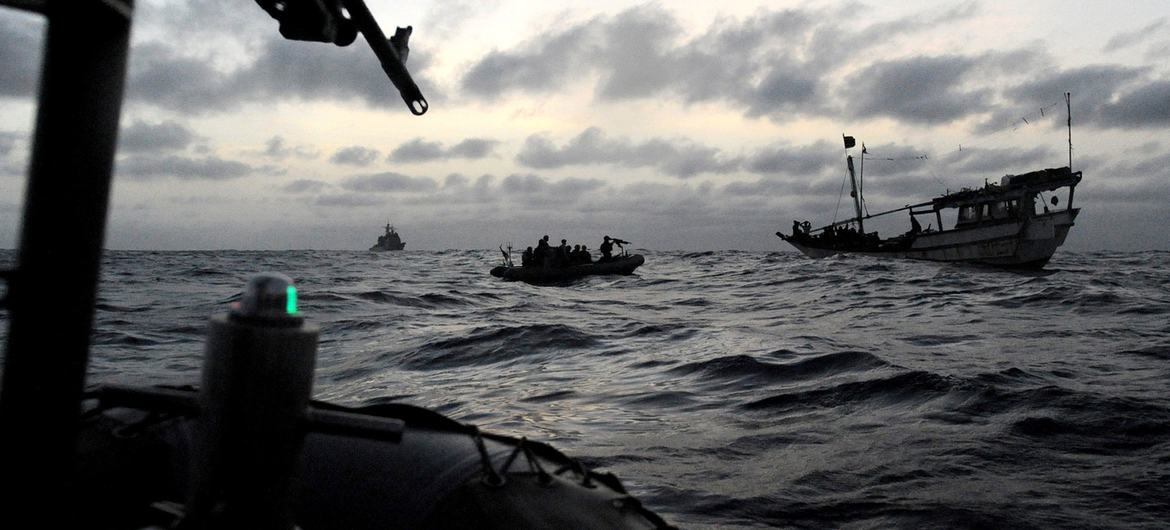
Counter-piracy operations are conducted in the Gulf of Aden and the east coast of Somalia. Photo by Mass Communication Specialist 2nd Class Ja'lon A. Rhinehart, U.S. Navy. Source:https://news.un.org/en/story/2026/07/1167876
- Economic pressure ashore. Many of the perpetrators in the Strait are members of low-level organised crime groups operating from remote Indonesian islands, often driven by unemployment and poverty to supplement their income at sea. The incidents themselves reflect this: opportunistic, non-confrontational thefts of stores, spares and scrap metal, typically carried out at night from small boats.
- A thinning security presence in the West. Meanwhile, off the Horn of Africa, the naval deterrent that suppressed Somali piracy in 2023–24 has been stretched. Following the crisis in the Gulf and the Strait of Hormuz, a significant share of international naval assets — including much of the Indian Navy's contribution — has been redeployed north to protect tanker traffic and energy routes. Counter-piracy officials warn this has created a more permissive environment for pirate groups along the Somali coast.
- And the weather. The same officials have pointed to something more elemental behind the recent resurgence off Somalia: "unusually calm sea conditions for this time of year, a result of the delayed onset of the south-west monsoon season in the Indian Ocean, which are conducive to pirate operations." — an observation made during a specific window earlier in 2026, when the monsoon was slow to establish.
At the time of publication, the south-west monsoon is firmly in full swing, as reflected in Weathernews' Weekly Indian Ocean maritime forecast, which includes forecaster commentary on current conditions across the Arabian Sea and Bay of Bengal.
The Weather Element
At sea, every activity answers to the weather — and piracy is no different. The small, open boats that pirates rely on: skiffs, speedboats, converted fishing craft cannot operate safely in heavy seas, so rough water sharply raises the cost and risk of an attack. This is why piracy has traditionally followed a seasonal rhythm in monsoon-affected regions: attacks fall away when the seas turn rough, and pick up again once the water calms.
Arabian Sea
In the Arabian Sea, the Southwest Monsoon drives significant wave heights of 4 to 5 metres across the open basin, sustained by strong winds over a long fetch. Reported piracy incidents (marked in orange) do not occur in this open water. Instead, they concentrate along the calmer coastal margins of the Gulf of Aden and the Somali coast, where wave heights fall to around 1 to 2.5 metres.
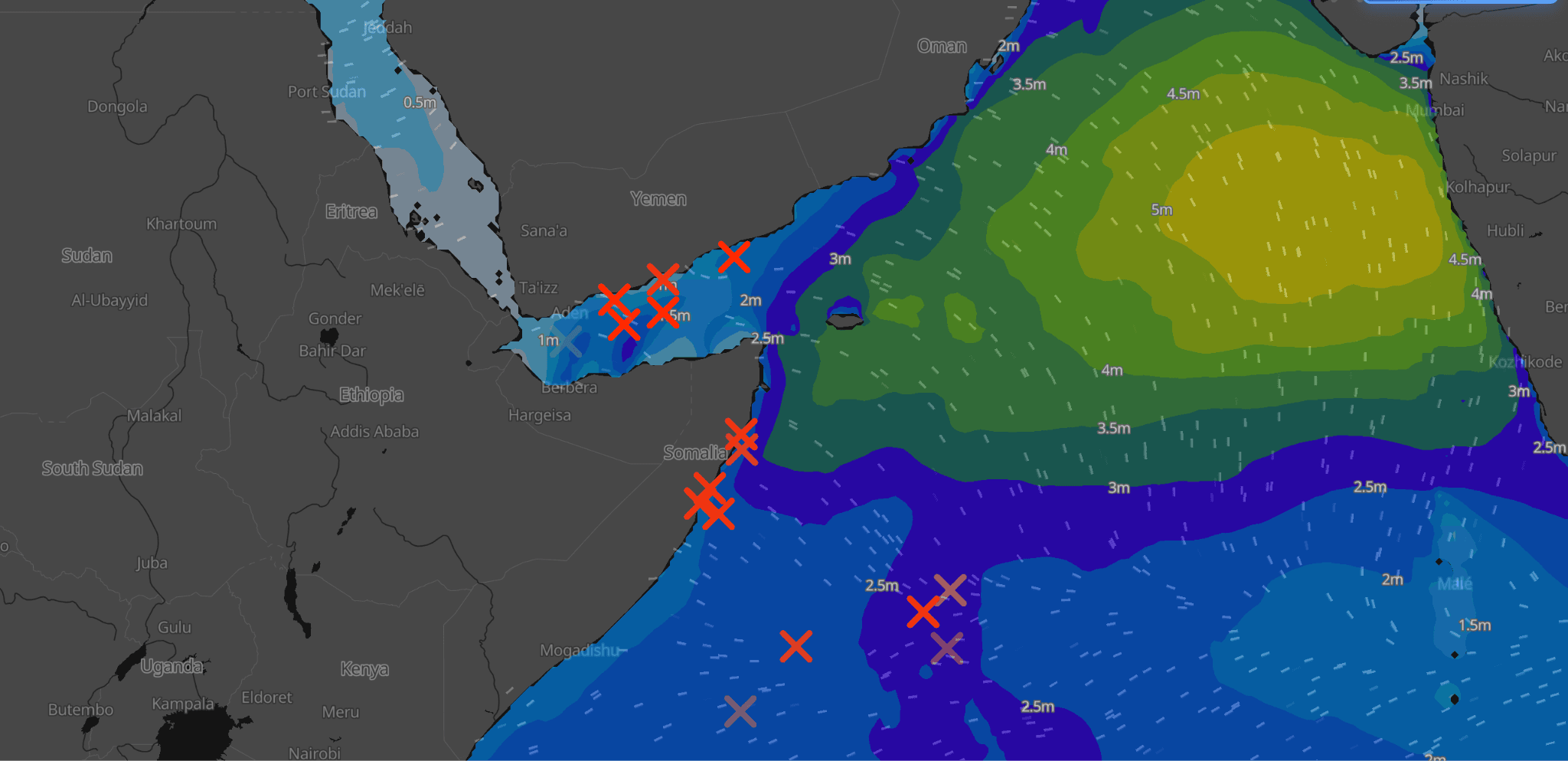
Piracy incident data and significant wave heights displayed on SeaNavigator, July 2026.
Singapore Strait
The Singapore Strait shows the opposite pattern. Sheltered between the Malay Peninsula and Sumatra, it stays relatively calm, with significant wave heights across the channel of around 0.5 to 1 metre. Open water only builds to 2 metres further out in the South China Sea.
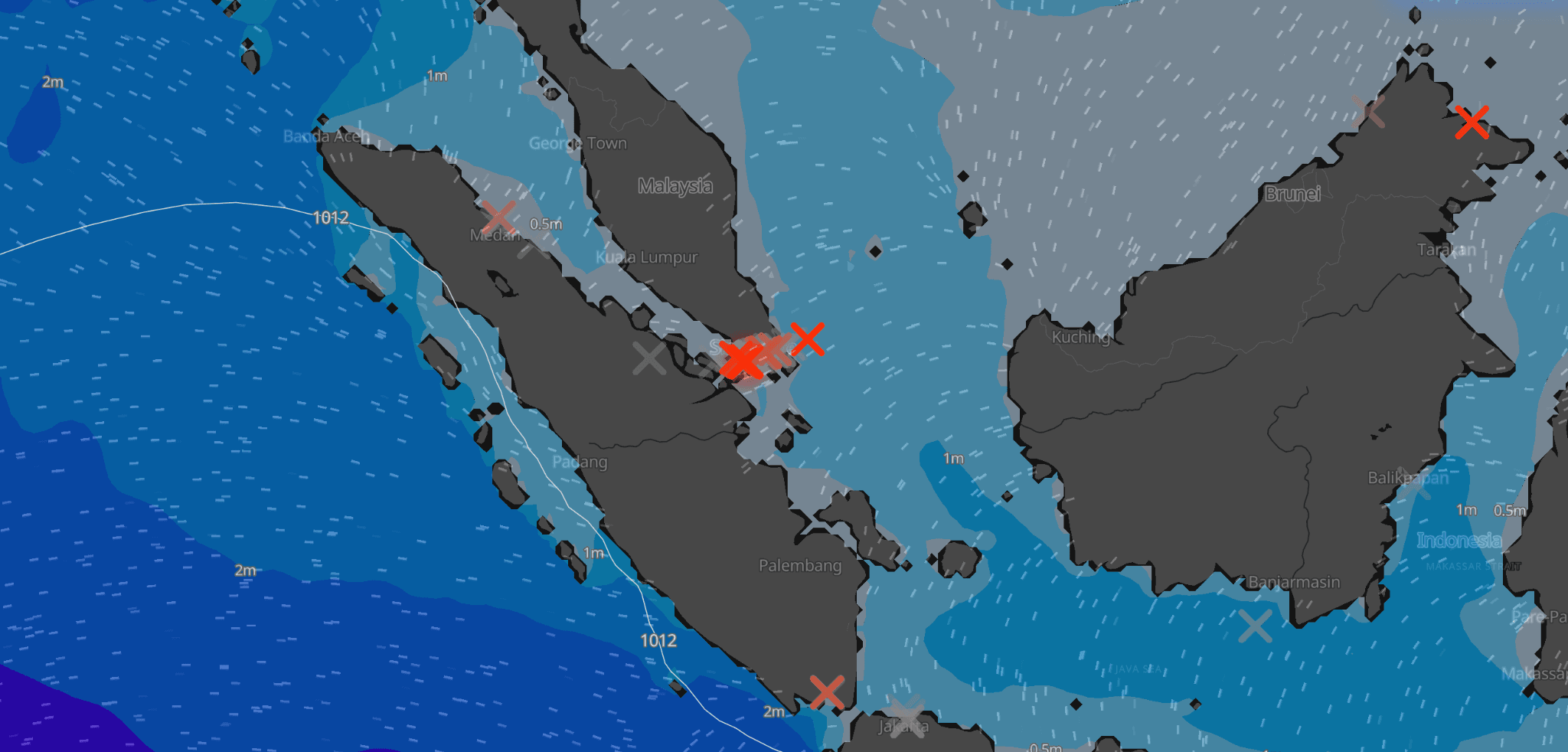
Piracy incident data and significant wave heights displayed on SeaNavigator, July 2026.
The two maps show the same relationship: where seas are rough, incidents are sparse and stay near the coast; where seas are calm, incidents concentrate.
What This Means for Mariners
Weather shapes the odds, but it never removes the threat.
Even in the roughest season the danger doesn't disappear: in mid-2026 the Joint Maritime Information Center warned that hostile small-craft activity remained elevated across the Gulf of Aden despite the southwest monsoon, and the IMO's Secretary-General cautioned that the threat "has not receded and continues to warrant vigilance."
The rest of the response lies in the things a vessel can control. Regional authorities and the shipping industry, through the Information Fusion Centre (IFC) in Singapore, recommend a set of straightforward measures for transiting crews:
- Maintain light and access discipline — keep a single, controlled entry point monitored from the bridge, and light the weather deck and poop deck at night.
- Watch the likely boarding points — the vessel's aft and the gaps near mooring bollards, where perpetrators often climb aboard using long poles or hooked ladders on vessels with low freeboard.
- Keep an elevated, all-round lookout — especially in the Phillip Channel and during the slow turns where vessels are most exposed — and sound the alarm the moment suspicious craft are sighted.
- Combine measures for effect — deck and accommodation lighting, an alert watch, and an early alarm together deter far more than any single step.
- Avoid confrontation — injuries typically occur only when crews resist; the guidance is to comply and prioritise safety.
- Report promptly — alert local authorities and the IFC immediately, and preserve CCTV and photographs to aid identification.
For the full set of recommended measures, see the Information Fusion Centre's guidance on deterring unauthorised boardings in the Singapore Strait.
Piracy vs. armed robbery: Under Article 101 of the United Nations Convention on the Law of the Sea (UNCLOS), piracy is defined as an illegal act of violence or detention committed on the high seas — in international waters beyond any single state's jurisdiction. Incidents that take place within a country's territorial or archipelagic waters fall instead under the International Maritime Organization's definition of armed robbery against ships (IMO Resolution A.1025(26)).