

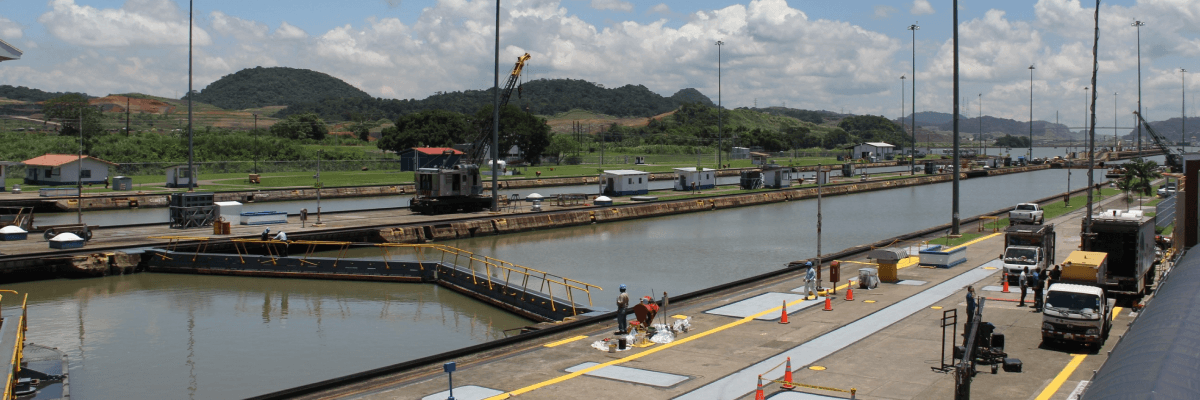
The Panama Canal Authority (ACP) announced on August 21 that it will cut the number of vessels permitted to transit the canal each day, down to 34 ships from September 3, and further to 32 ships from September 15. For context, the canal registered an average of 35 daily transits through June 2026, in line with vessel demand, against a maximum capacity of around 40 crossings per day, according to Reuters. The new limits mark a clear step down from both figures.
This follows an earlier announcement on August 5, when the ACP said draft restrictions for vessels using the Neopanamax locks would be tightened in stages: 48 feet (14.63m) from August 26, dropping again to 47.5 feet (14.48m) from September 3. Restrictions have in fact been in place continuously since early July.
The underlying cause is water, not infrastructure. An El Niño-driven decline in rainfall has been ongoing throughout the year, and water levels at Gatún Lake — the canal's main freshwater source — are under pressure. So far, the disruption seen in 2023 has not been repeated, but the situation is worsening, and further restrictions cannot be ruled out depending on how rainfall trends over the coming months.
Why Does a Water Shortage Stop Ships From Passing?
It's a fair question, and one worth understanding, because it explains why Panama's canal behaves so differently from, say, Suez.
The Panama Canal connects the Atlantic and Pacific Oceans, which sit at different elevations. To bridge that gap, ships are raised and lowered through a system of locks. Each transit consumes a large volume of freshwater, drawn from Gatún Lake and Alajuela Lake, meaning the canal's entire operation is hostage to how much rain falls in the surrounding watershed.
When lake levels drop, the risk of a ship's hull scraping the canal floor increases. The ACP's response is to impose draft restrictions, forcing carriers to lighten their loads so vessels float higher. The ship can still pass, but it can no longer sail full. Combine that with fewer daily transit slots, and the bottleneck compounds quickly.
Learning From 2023
The current situation is being watched so closely precisely because of what happened in 2023–2024. That year's El Niño delayed the wet season and prolonged the dry one: rainfall across the canal watershed came in 25.6% below the 73-year average, with October 2023 recording the driest October since 1950 (41% below normal). A severe drought followed, triggering both draft and daily-transit restrictions.
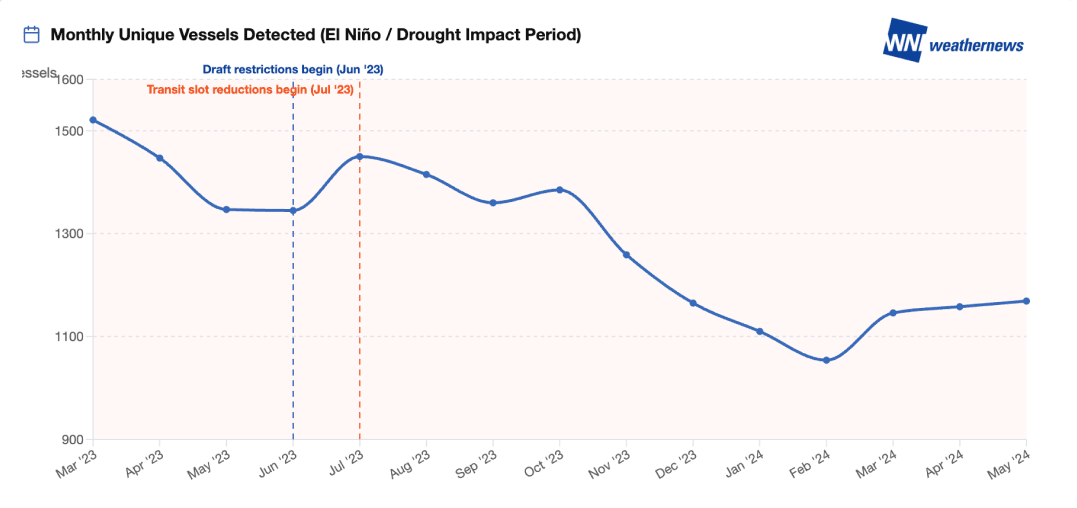
AIS (Automatic Identification System, source data: Marine Traffic by Kpler) vessel-tracking data illustrates the scale of the impact: 1,450 ships transited the canal in July 2023, right as restrictions began. By February 2024, that figure had fallen to 1,054, a 27.3% drop. (Seasonal demand and rerouting also played a role, so the decline isn't attributable to restrictions alone.)
The knock-on effects were felt well beyond Panama. Vessels queued offshore, freight costs climbed, and some carriers rerouted via the Cape of Good Hope or the Suez Canal instead. Container ships, car carriers, dry bulk vessels, and LPG carriers were all affected.
Where Things Stand Now: "Limited Impact — For Now"
This year's El Niño is forecast to develop into a "super El Niño," with forecasters putting the probability of El Niño conditions persisting through winter at 100%, potentially reaching historic intensity. Weathernews' outlook for September–November points to below-average rainfall for Panama, while long-range models from Japan's Meteorological Agency and the European Centre for Medium-Range Weather Forecasts converge on the same signal: higher-than-average temperatures paired with lower-than-average rainfall across the canal watershed.
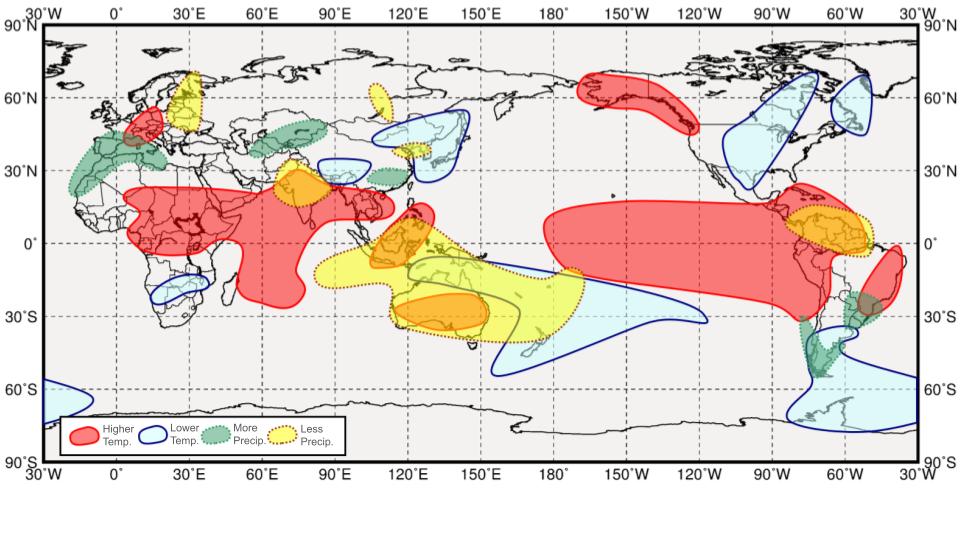
Forecast temperature and rainfall anomalies during El Niño, September–November 2026; image source: Japan Meteorological Agency (JMA), Climate Prediction Division. El Niño Monitoring and Outlook. Available at: https://www.data.jma.go.jp/cpd/data/elnino/learning/tenkou/sekai1.html#son. English translation adapted by author.
Yet the numbers so far tell a more reassuring story than 2023:
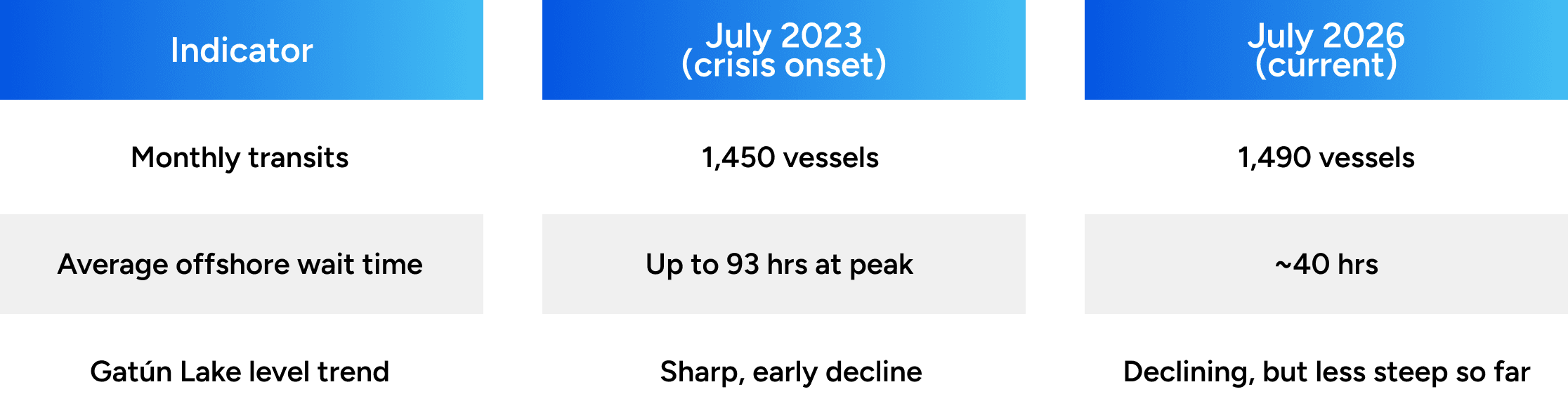
Rainfall since April 2026 has run around 30% below the historical average, and since June 2026, has actually tracked lower than the equivalent period in the 2023 drought. Lake levels have also begun falling sharply since April 2026. In other words: the underlying risk factors look comparable to, or even slightly worse than, 2023. It's just that the visible consequences (queues, transit volume) haven't caught up yet. That gap is worth watching, not celebrating.
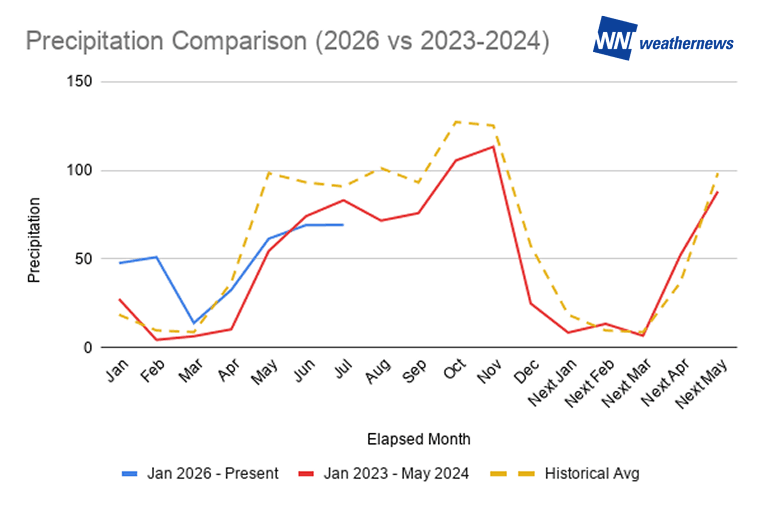
Monthly observed precipitation; data source: Panama Canal Authority (ACP). Available at: https://evtms-rpts.pancanal.com/eng/h2o/index.html. Data adapted by author by averaging monthly precipitation data from PA03 (Colón Province) and PA08 (Panamá Province).
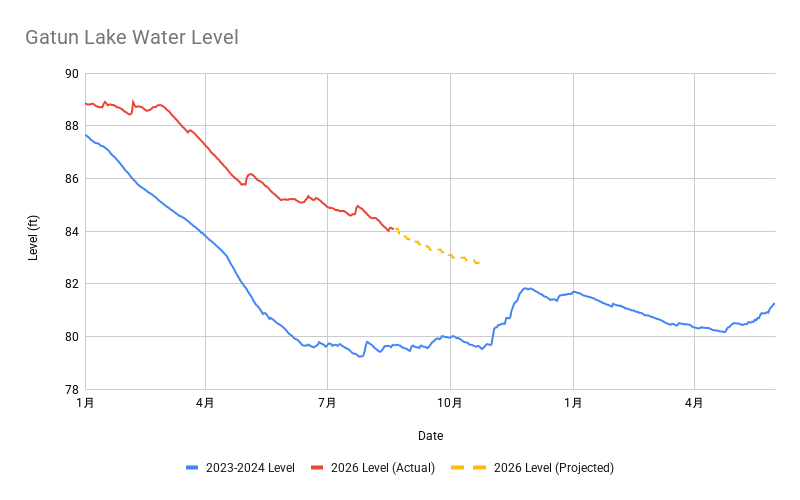
Gatun Lake water level; data source: Panama Canal Authority (ACP), observed and forecast values. Data adapted by author.
Why This Matters Beyond Panama
The canal is one of the world's most important corridors linking the U.S. Atlantic/Gulf coasts with Asia. Roughly 14.5% of all cargo transiting the canal either originates from or is bound for Japan, underlining how directly this affects trade flows across East Asia and Oceania more broadly.
LPG is particularly exposed. For example, around 62% of Japan's LPG imports come from the United States, much of it routed through Panama. In 2023, LPG carriers bound for Japan and South Korea increasingly diverted via Suez or the Cape, adding 14–16 days to transit times, driving up freight costs, and feeding through into domestic propane prices across the region.
U.S. grain and agricultural exports, another major canal cargo category, saw similar cost pressure in 2023 through reduced loading and rerouting, a dynamic relevant to importers across Asia-Pacific more generally.
No major supply disruption materialized last time, but a prolonged repeat could put upward pressure on household gas prices and imported food costs in markets that depend on this route.
What to Watch Next
There's no clean answer yet to whether 2026 will mirror 2023. What's clear is that the two variables that matter — rainfall and lake water levels — are trending in a direction that warrants attention rather than alarm at this stage.
Notably, El Niño's effects on the canal have historically been strongest in the year following onset, which is why the ACP is already modeling operational scenarios for 2027.
For carriers, shippers, and anyone tracking global supply chains, the lesson from 2023 still holds: canal water levels are no longer just a regional infrastructure story. They're a variable that can move freight costs, energy prices, and food prices worldwide. The second half of 2026 will be a period to keep an eye on the rain gauge as much as the shipping schedule.