


Tens of thousands of ships navigate the world's oceans every day, carrying the oil, LNG, and goods that sustain our daily lives. In late February 2026, the Strait of Hormuz—which typically handles about 20% of the world's oil shipments and 30% of its LNG—was effectively closed.
To understand the long-term impact of this closure, Weathernews leveraged real-time AIS signals (AIS Source Data: Marine Traffic by Kpler) broadcast by approximately 90,000 IMO-registered vessels to track weekly port calls across major energy sectors. While our previous analyses (1), (2) focused on the immediate maritime safety and weather risks for the 600+ vessels stranded inside the Persian Gulf, tracking this data two months later brings two broader, global changes into sharp relief: the fragility of a heavy reliance on the Middle East, and the rapid emergence of new supply routes.
Three Structural Shifts Highlighted by the Closure
Looking at the AIS data as a whole reveals deeper structural shifts in global maritime trade:
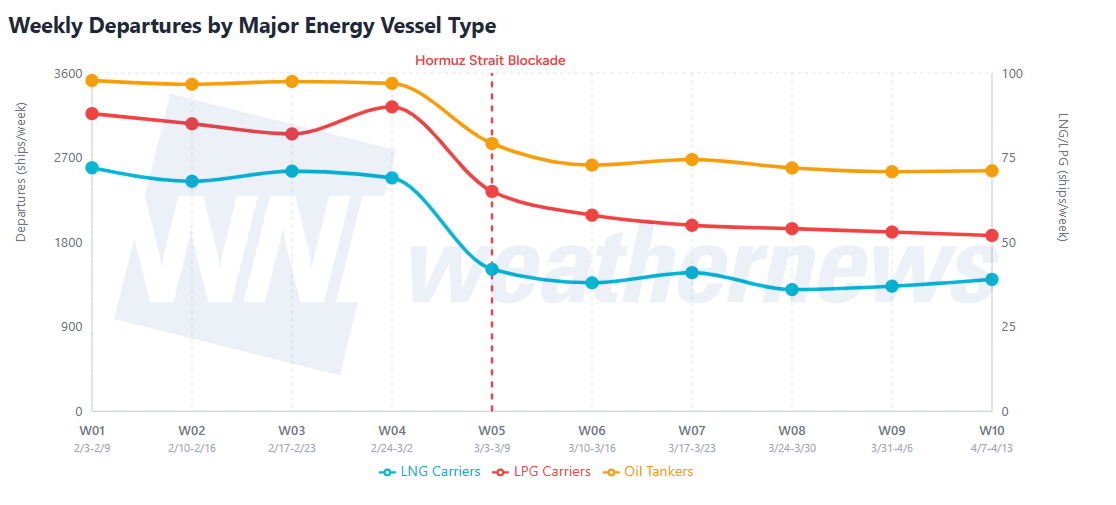
1. Disparity of Impact by Energy Type: The decline rates follow a clear order: LNG (43%) > LPG (35%) > Oil (27%). The gas sector has seen the greatest impact. This is largely because oil can be rerouted via pipelines or Red Sea alternative ports, whereas LNG relies heavily on specialized, dedicated terminals, making flexible adjustments more difficult.
2. Resilience of Asian Hub Functions: Singapore has maintained relatively high volumes compared to other regions, retaining 84% of its pre-closure oil traffic, 81% for LNG, and 71% for LPG. As a major transit hub for Southeast and East Asia, Singapore is successfully leveraging its robust port infrastructure to receive shipments from highly diversified sources.
3. Rise of New Supply Sources: Supply bases that do not rely on the Strait of Hormuz are gaining prominence, such as Cilacap (Oil: 400% of pre-closure levels) and Balikpapan (Oil: 109%) in Indonesia, as well as Arzew (LNG: 112%) in Algeria. From an energy security perspective, we are witnessing early signs of an accelerated diversification of supply sources.
Crude Oil Tankers: Major Middle Eastern Ports Decline as Alternative Routes Emerge
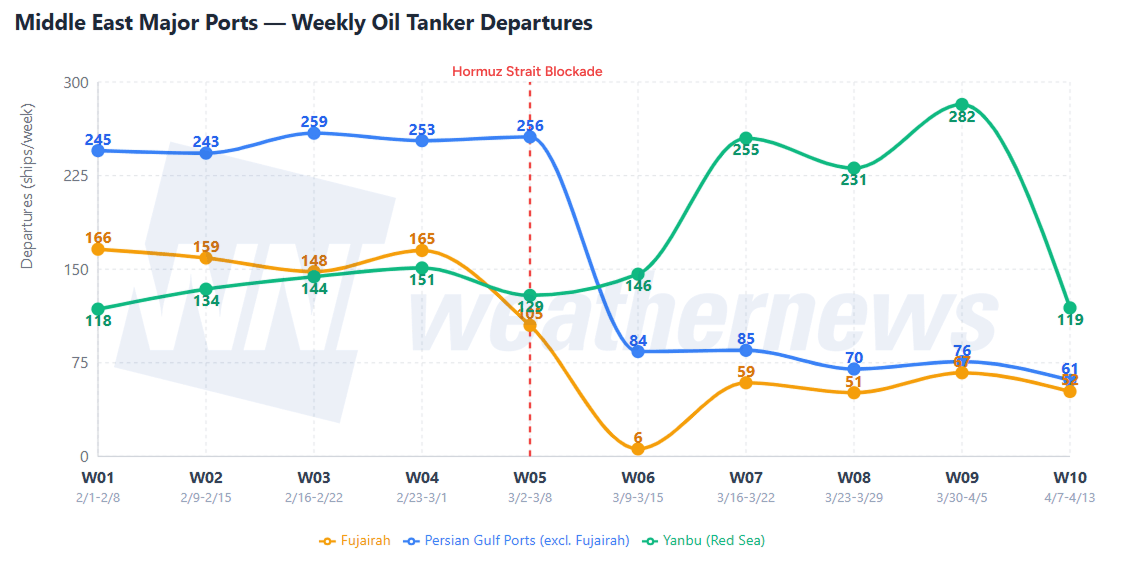
The impact of the closure remains most evident at oil export terminals along the Persian Gulf.
Major ports within the Gulf, which saw about 240 port calls per week until late February, declined to approximately 70 to 80 by the end of March—a drop to just 30% of their normal volume. Fujairah in the United Arab Emirates handled around 160 vessels weekly in early February. By the second week of March, that number had fallen to just 6 vessels, and by the second week of April, it remained in the 50s—less than a third of its pre-closure levels.
Conversely, Yanbu in Saudi Arabia, which faces the Red Sea and bypasses the Strait of Hormuz, commands attention. In the third week of March, vessel departures rose to 255—more than double the pre-closure figure of 130. This port is gaining prominence as a critical alternative export route bypassing the Persian Gulf. Globally, weekly crude oil tanker port calls dropped from approximately 3,500 before the closure to about 2,560 by the second week of April, representing an overall decrease of 27%.
LNG: Operations at Major Export Hubs Effectively Halted
The reduction in the Liquefied Natural Gas (LNG) sector has been particularly pronounced. Ras Laffan in Qatar, one of the world's premier LNG export hubs, recorded 9 departures in the fourth week of February, just before the closure. The following week, it dropped to zero. As of the second week of April, only a single vessel has departed. Das Island in the United Arab Emirates also continues to report zero port calls. The effects extend beyond the Middle East. Sabine Pass in Texas, USA, saw activity decrease to 17% of its pre-closure volume, and Sabetta in the Russian Arctic (Yamal LNG project) is operating at 29% of previous levels. Amidst this downturn, Arzew in Algeria presents a notable exception, increasing its activity to 112% compared to pre-closure levels. Situated on the Mediterranean and shielded from the Hormuz bottleneck, this port is emerging as a vital alternative hub for European LNG supplies. Overall weekly LNG departures fell from approximately 70 vessels before the closure to 39 by the second week of April. This 43% drop marks the most significant decline among the three categories.
LPG: A Quiet But Steady Contraction
While the movements of Liquefied Petroleum Gas (LPG) carriers have been less volatile, a uniform decline across all ports is evident. Weekly totals dropped from 80–90 vessels pre-closure to 52 by the second week of April, a 35% decrease. While Middle Eastern ports like Ras Laffan (down to 57% of pre-closure levels) and Ras Tanura (down to 53%) experienced significant drops, we have not observed the rapid surge in alternative ports seen with crude oil tankers. Because LPG transport volumes are smaller, the development of alternative routing may be lagging. Furthermore, the Russian port of Ust-Luga recorded zero departures in the latest week.
Summary
As we approach the two-month mark since the effective closure of the Strait of Hormuz, AIS data clearly illustrates that global energy transport is rapidly shifting from a heavy reliance on the Middle East to a more diversified and distributed model. However, the recovery of gas-centric energy supplies—particularly LNG—is lagging, and establishing stable alternative routes will likely take time.
Through real-time vessel tracking using AIS data, Weathernews will continue to monitor the latest trends in energy shipping. In future updates, we will also explore how these diversified routes are changing the weather risks encountered by vessels, particularly as they navigate unfamiliar supply chains and varying seasonal conditions.
Remarks: Target vessel types: All tanker classes. Port arrivals are defined as a change in AIS speed from 1 knot or more to less than 1 knot; departures are defined as a change from less than 1 knot to 1 knot or more. Please note that these port call counts may include instances of anchoring or vessels waiting offshore.