


The number of vessels passing through the Strait of Hormuz has once again fallen sharply.
An analysis of vessel positioning data (AIS) by Weathernews found that 226 vessels passed through the strait between July 12 and 18, down approximately 45% from 409 vessels the previous week. From July 19 to 25, the number remained low at 218 vessels. During the three days from July 26 to 28, the average was approximately 35 vessels per day, indicating that traffic continues to remain at a low level.
Disruptions in the Strait of Hormuz tend to attract attention primarily because of their potential impact on crude oil prices. However, the strait is also a critical shipping route for fertilizer.
According to the United Nations Conference on Trade and Development (UNCTAD), approximately one-third of global seaborne fertilizer trade passes through the Strait of Hormuz. If disruptions to shipping persist, the impact could extend to food supplies and prices through constraints on fertilizer availability and higher agricultural production costs.
At the same time, the El Niño event currently underway is expected to strengthen toward the end of the year. If delays in fertilizer supplies and rising fertilizer prices coincide with droughts, heavy rainfall, and changes in temperature patterns, the impact on crop yields and food supplies could become even more significant.
During the three days from July 26 to 28, the daily average was also approximately 35 vessels.
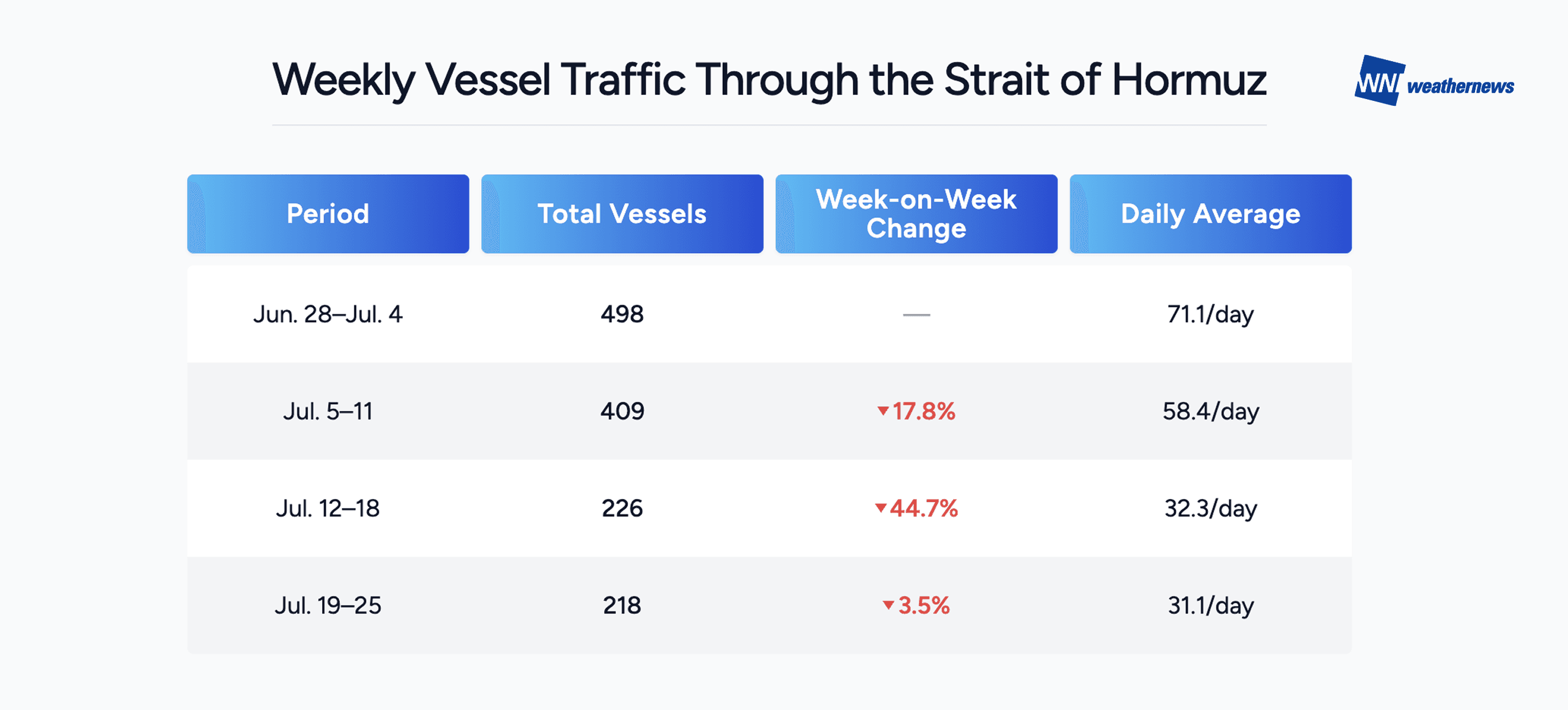
Changes in the Number of Vessels Passing Through the Strait of Hormuz
Approximately One-Third of Global Seaborne Fertilizer Trade Passes Through the Strait
According to an analysis by the World Trade Organization (WTO), fertilizer-related shipments traveling through the Strait of Hormuz to destinations outside the Persian Gulf almost completely stopped following the outbreak of the conflict. Urea prices rose from approximately $400 per metric ton before the conflict to more than $850 at one point in April, before falling to $453 in June. Although prices have declined from their peak, the fertilizer market remains highly sensitive to developments in the strait.
Higher fertilizer prices may feed through to grain prices with a time lag. An analysis by the International Monetary Fund (IMF) estimates that a 10% increase in fertilizer prices could lead to a 7% increase in grain prices approximately three months later.
The risk is not limited to higher fertilizer prices. There is also a supply-side risk that fertilizer may not arrive when it is needed.
The Food and Agriculture Organization of the United Nations (FAO) has pointed out that even delays of several weeks in fertilizer deliveries could cause farmers to reduce the amount of fertilizer they use or skip fertilization altogether. The effects could carry over into the following harvest, potentially putting pressure on food supplies from the second half of 2026 through 2027.
Approximately 16 million metric tons, equivalent to about one-third of global seaborne fertilizer trade, pass through the Strait of Hormuz.
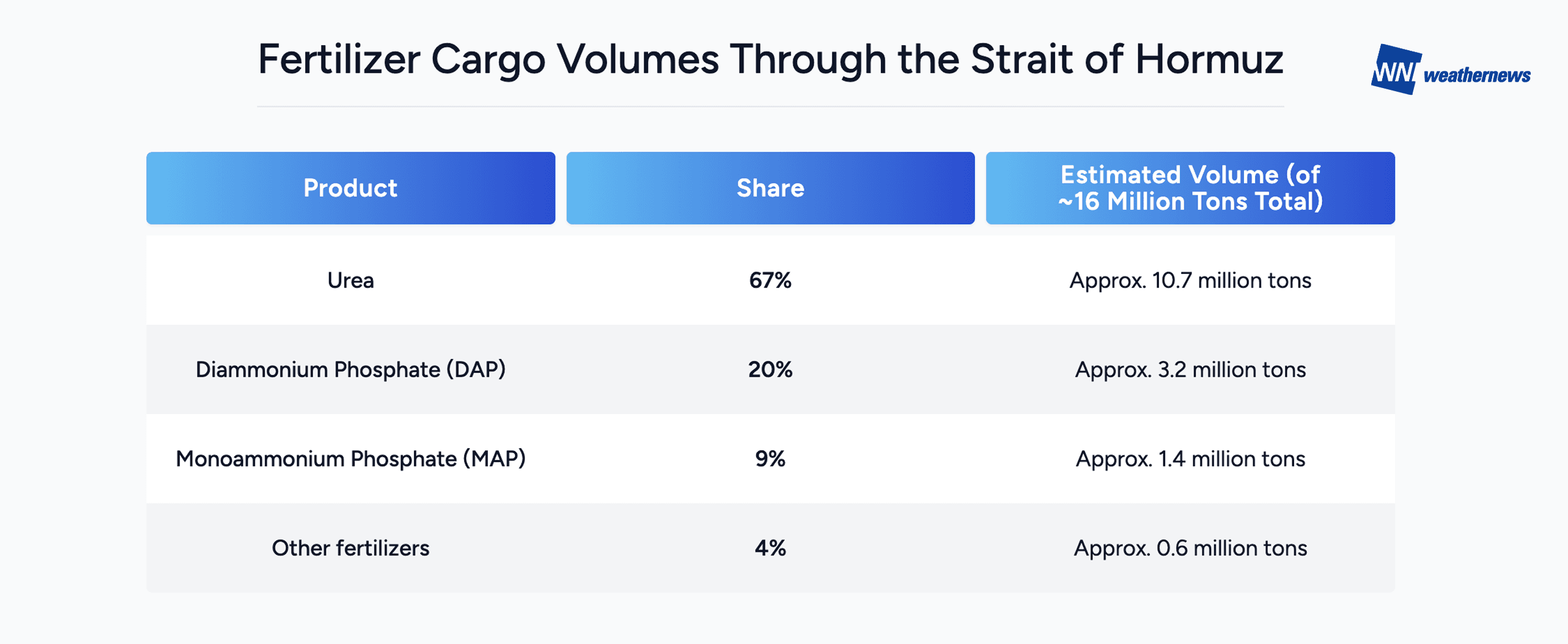
Data taken from UNCTAD, “Strait of Hormuz disruptions: Implications for global trade and development” (March 10, 2026). Table created by Weathernews Inc.
Volumes are approximate figures calculated from the total volume of approximately 16 million tons and the respective shares.
Japan Could Be Affected Through International Prices and Transportation Costs
Japan relies heavily on imports for most major fertilizer raw materials, including urea, ammonium phosphate, and potassium chloride. However, Japan's main sources of procurement are outside the Middle East, meaning that disruptions in the Strait of Hormuz do not directly translate into a halt in fertilizer supplies to Japan.
At the same time, according to Japan's Ministry of Agriculture, Forestry and Fisheries (MAFF), raw materials account for approximately 60% of the manufacturing costs of chemical fertilizers, making fertilizer prices highly sensitive to international raw material prices and transportation costs. As a result, disruptions in the Strait of Hormuz could affect domestic fertilizer prices and agricultural production costs through higher international prices and shipping costs.
Such increases in fertilizer prices can also place a burden on farmers in major agricultural producing regions. Hokkaido accounts for 100% of Japan's sugar beet production value and is the country's leading production region. During the previous period of rising fertilizer prices, fertilizer costs for sugar beet cultivation increased by approximately 42%, from ¥24,653 per 10 acres in 2022 to ¥35,064 in 2023, demonstrating the significant increase in the burden placed on farmers by higher fertilizer prices.
El Niño Expected to Strengthen Toward the End of the Year
Adding to these concerns is the weather risk associated with El Niño.
The U.S. National Oceanic and Atmospheric Administration (NOAA) forecasts an 81% probability of a “very strong El Niño” between October and December 2026.
According to Weathernews' crop yield forecast, U.S. wheat yield in 2026 is expected to be approximately 2.3% below the average of the past five years. If El Niño strengthens further, uncertainty surrounding yields in major producing regions could increase.
Strong El Niño events in the past have also affected agricultural production and prices. According to the FAO, sugar and palm oil production were affected between 2015 and 2016, while the sugar price index and vegetable oil price index in 2016 were both higher than the previous year.
Japan also experienced unusual weather conditions during the same period, including a cool summer in western Japan and unusually high temperatures in late autumn. MAFF reported frost damage to wheat and other crops whose growth had accelerated due to warm winter temperatures, as well as “peel puffing” in satsuma mandarins in western Japan. These conditions affected crop yields, quality, and storage life.
The effects of El Niño vary by region and crop. However, if high temperatures, drought, or uneven rainfall coincide with critical growing periods, crop yields and quality could decline, potentially contributing to higher food prices.
Two Risks: Fertilizer Supply and Weather
If farmers are unable to apply sufficient fertilizer due to higher prices or delayed supplies, and unfavorable weather associated with El Niño occurs at the same time, downward pressure on crop yields could intensify. If lower yields and higher production costs spread across major agricultural regions, international and import prices for agricultural products could rise, potentially feeding through to domestic food prices.
Because the effects of delayed fertilizer supplies may not become apparent until the following harvest or later, it will be important to monitor planting and fertilization conditions in major producing regions, changes in weather associated with El Niño, and price trends for fertilizers and agricultural commodities together.
Vessel movement data (AIS) uses MarineTraffic data provided by Kpler.