

As maritime security risks remain elevated across critical Middle Eastern chokepoints, global trade flows are continuously being rerouted, pushing an unexpected route into the spotlight.
Shipping lines are showing a growing interest in the Northern Sea Route (NSR) in the Arctic as a viable alternative to the traditional southern routes. This pivot raises the question of: Is the NSR becoming a functional commercial shortcut, or simply a temporary seasonal alternative driven by geopolitics?
About The Northern Sea Route
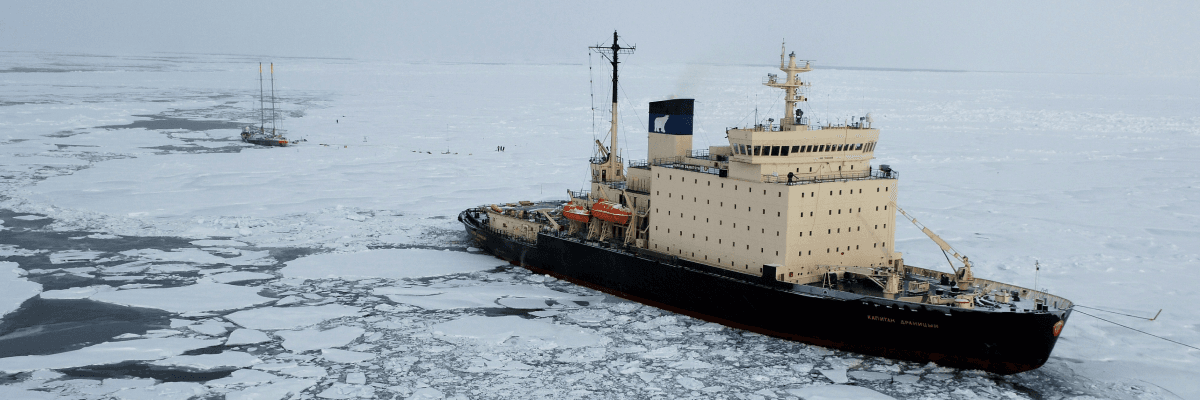
The Northern Sea Route (NSR) is far from a newly discovered passage. Historically, severe Arctic ice conditions, the requirement for specialized ice-class hulls, and steep Russian icebreaker transit tariffs made the route commercially unviable compared to traditional southern sea lanes.
For decades, the NSR functioned primarily as a domestic supply network for remote Siberian towns and an export route for Russian Arctic commodities like nickel, timber, and Liquefied Natural Gas (LNG) rather than as a general international trade artery. Cargo volumes reflect that: from roughly 0.1 million tonnes of transit cargo in 2010, total NSR traffic grew to a record 37 million tonnes in 2025 — real growth, but the overwhelming majority of it is still tied to Russia's own resource exports, not third-country trade passing through.
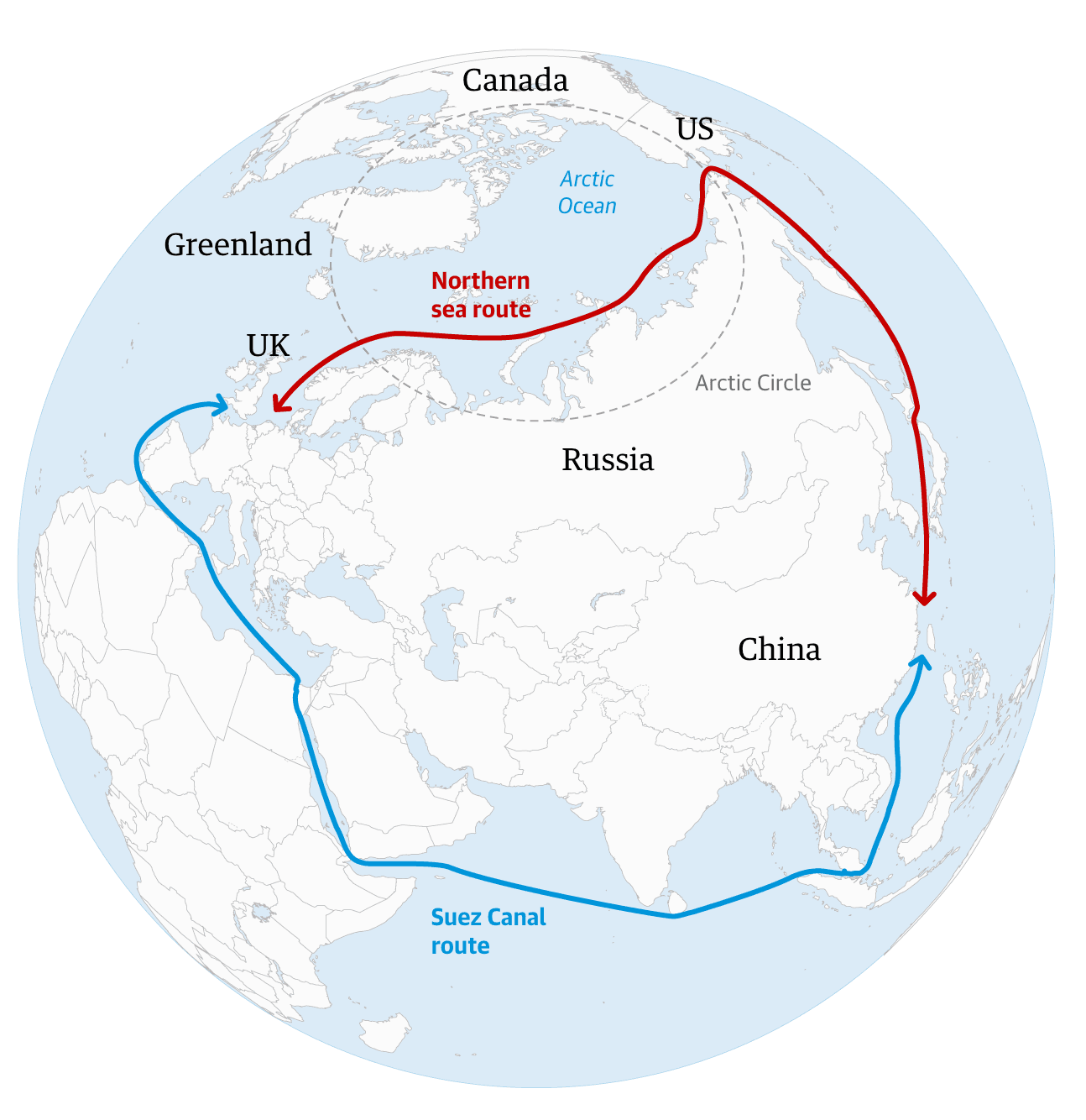
Asia–Europe Shipping Corridors: The Northern Sea Route (red) vs. the traditional Suez Canal route (blue). (Source: The Guardian)
Changing Conditions
However, in today’s volatile geopolitical landscape, the Asia–Europe trade lane faces a stark choice: navigating high-risk Middle Eastern chokepoints like the Suez Canal (a typical 40-day journey), or taking a costly 50-day detour around Africa’s Cape of Good Hope. Under these conditions, the seasonal Arctic shortcut has grown increasingly attractive, with container lines capitalizing on open-water windows to move manufactured goods directly between Asia and Europe.
The clearest proof of this commercial shift: Chinese carrier Sea Legend’s liner service between Ningbo-Zhoushan and Felixstowe (UK) now completes transits via the Arctic in as little as 18-20 days, compared to 40+ days via the Cape of Good Hope.
The 2026 Surge: A Season Unlike Any Before It
When looking at the AIS data of vessels transiting through the NSR, the seasonal rhythm of the NSR holds steady across all three years in the data.
Transits fall through the ice season (roughly December–April), pick up through the shoulder months (May and November), and peak during the open-water window (June–October). What's changed is the scale of that peak.
Comparing June to August year over year, 2024 ran 386–556 total transits per month and 2025 was similar with around 402–593. However 2026 has broken that pattern entirely, with 765 in June, 1,081 in July, 952 in August (through August 27, still a partial month) which is roughly double the equivalent months in 2025.
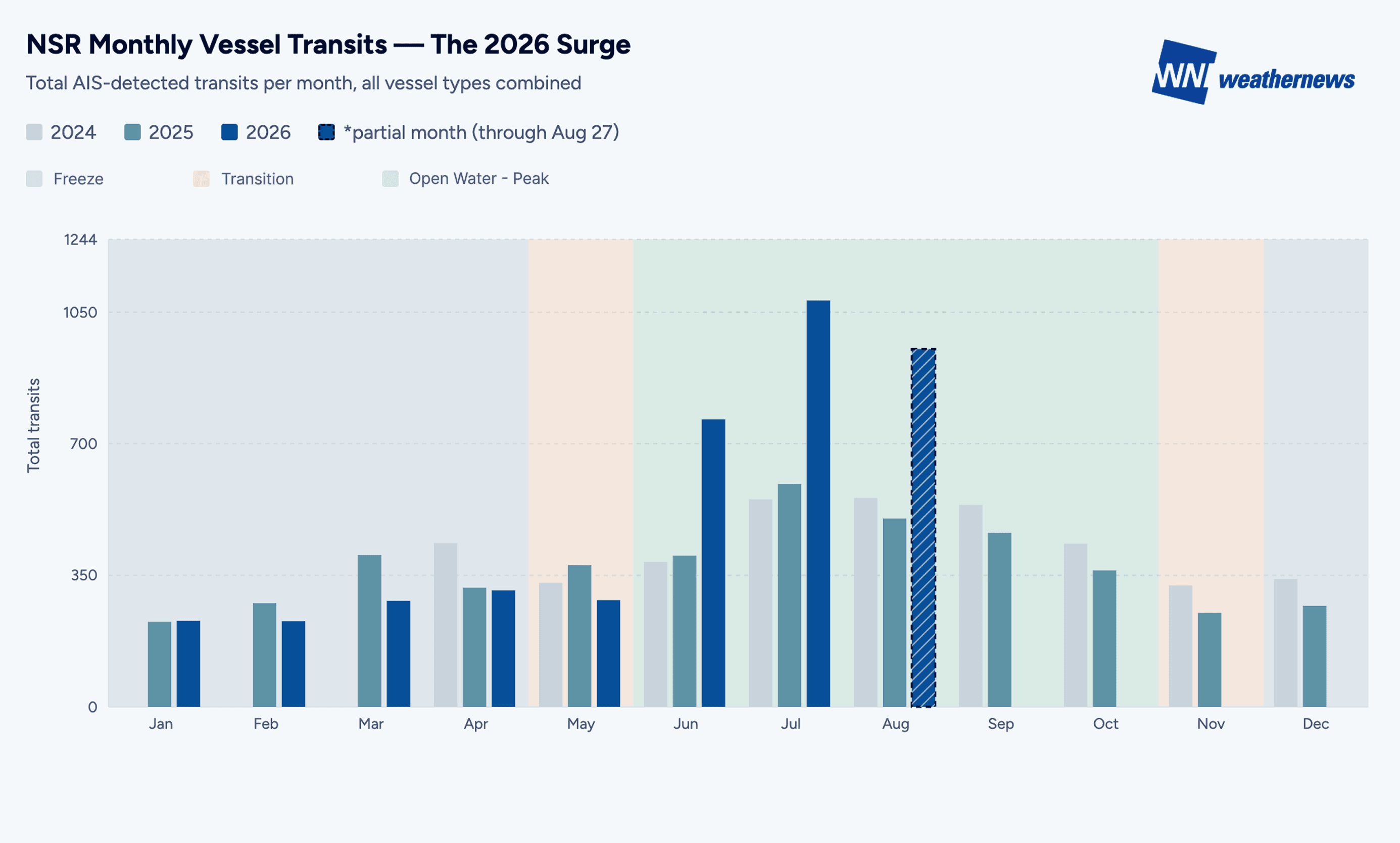
NSR Transit Surge (2024–2026): AIS-detected monthly vessel transits along the Northern Sea Route, highlighting the sharp volume increase during the 2026 open-water peak. (Source: Weathernews Inc.)
That surge isn't evenly distributed across vessel types. Across the June–August peak season, "Other" transits more than doubled year-over-year (+139%), by far the largest driver of the overall jump. Tankers rose sharply too (+49%), while cargo grew more modestly (+22%) but is still running at a multi-year high in absolute terms, with monthly transits in the most recent month near 100 in each direction, overall a level the route hasn't consistently sustained before.
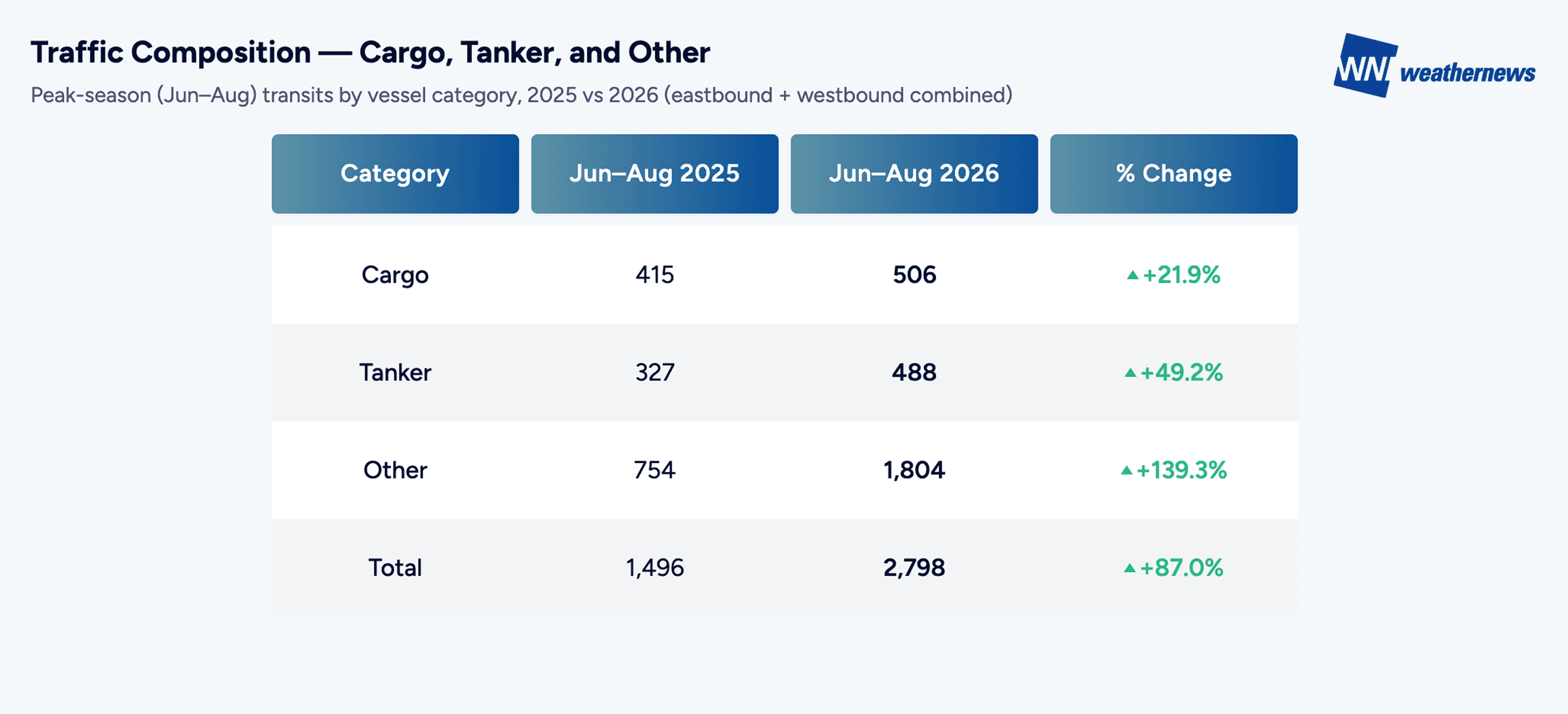
NSR Transit Breakdown by Vessel Type (Peak Season 2025 vs. 2026). (Source: Weathernews Inc.)
Whether driven by declining sea ice, geopolitical rerouting, or expanding trade partnerships, the surge coincides with growing interest in the route among various stakeholders.
The Operational Tradeoff: Navigation Windows & Arctic Risk
While geopolitical pressures in the Middle East have elevated the strategic appeal of the Northern Sea Route, physical climate realities remain the ultimate governing factor.
1. Sea Ice
Global headlines have highlighted a rapidly warming Arctic, with data from the Japan Meteorological Agency revealing an annual loss of a Hokkaido-sized area of minimum sea ice and the winter of 2026 setting a record for the lowest Arctic sea ice maximum ever observed. Yet Weathernews’ April 2026 study on the Bering Sea Ice Anomaly reminds us that a warming climate does not eliminate freezing hazards; it makes them dangerously volatile.
In March 2026, despite record-low sea ice across the broader Arctic, sudden localized freezes expanded ice coverage by 60% across key access gateways in just two weeks. The resulting logistical disruptions prove that operators targeting northern passages cannot rely on long-term climate averages alone. Extreme regional volatility at the Pacific entrance to the NSR can choke access through Arctic corridors overnight.
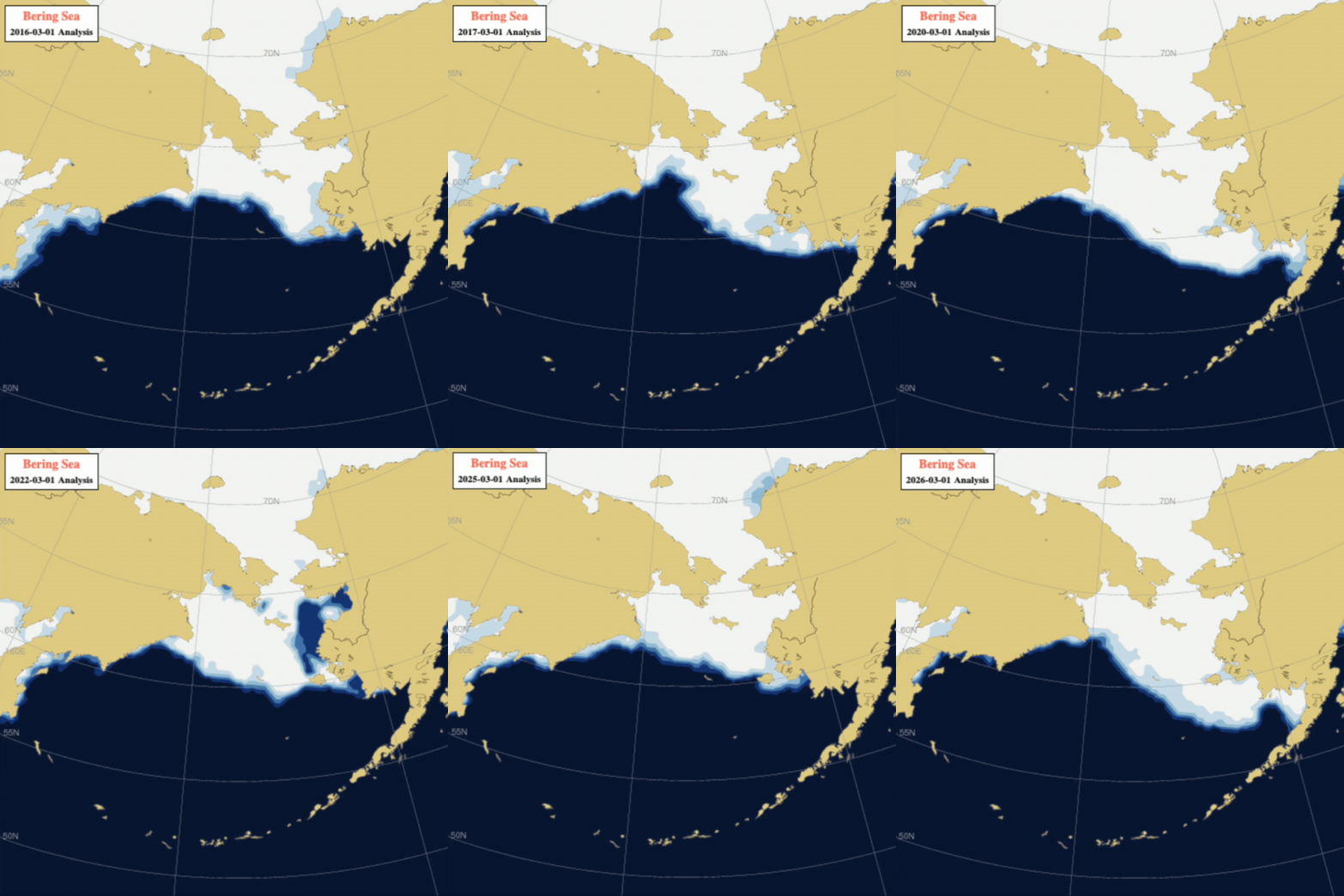
Bering Sea Ice in March: 2016–2026 Progression (Source: Weathernews Inc.)
2. Operational Risks
Even within the "open" season (Jul–Oct), environmental conditions across the NSR show a clear divergence. WNI’s 10-year climatological baseline across the route's key chokepoints highlights this dynamic: while average air temperatures peak at a modest 7–8°C in July and August, they plunge back below freezing by October.
Meanwhile, average wind speeds remain steady at 5 to 6 m/s year-round, gradually picking up through late summer and autumn. This baseline underscores that even during August—nominally the mildest, most favorable month for Arctic transit—operators contend with near-freezing averages and persistent winds.
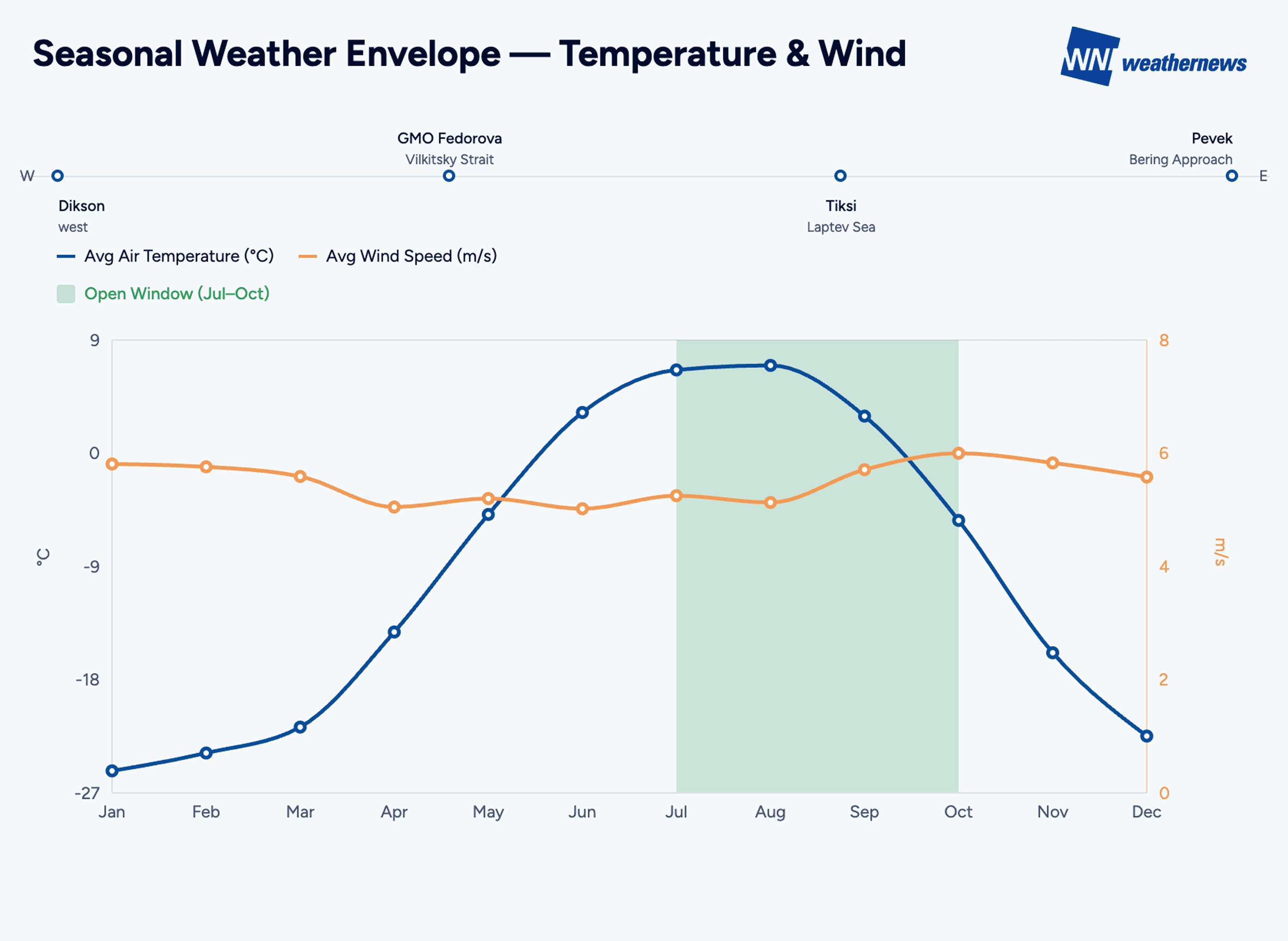
Monthly Temperature and Wind Profile Along Key NSR Transit Points (Jul–Oct Open Window Highlighted). (Source: Weathernews Inc.)
3. Environmental Risks
As seen in the recent expansion of the Emission Control Area (ECA) in the North-East Atlantic, environmental risks must be actively accounted for alongside operational planning. In the high Arctic, these environmental exposures become even more acute:
- Pollution & Spill Response: Heavy Fuel Oil (HFO) is banned in Arctic waters by the IMO as it is nearly impossible to clean up or recover once spilled into cold water or trapped under sea ice.
- Sparse Search & Rescue (SAR) Infrastructure: With minimal port infrastructure and vast distances between emergency response stations, specialist spill-response or salvage teams could take weeks to reach a remote incident.
Strategic Outlook
Whether the Northern Sea Route becomes a routine commercial corridor or remains a niche seasonal alternative remains an open question. The route cannot replicate the year-round capacity of traditional passages like Suez or Hormuz, yet growing Asian trade interest and trial transits highlight its potential during southern chokepoint instability.
However, beyond the benefits of time and distance for global commerce, geopolitical conditions must also be taken into account. Transit along the NSR requires navigating Russian regulatory permits, icebreaker escorts, and complex sanction environments, adding an essential layer of consideration when evaluating the overall viability of the route.