

2026 Typhoon Season Outlook: Above-Normal Activity as El Niño Intensifies
Weathernews' latest seasonal analysis projects an above-normal typhoon season for the Northwest Pacific, with an estimated 27 to 29 tropical storms or typhoons forming over the full year. A developing El Niño, with the potential to rank among the strongest on record, is the dominant atmospheric driver for the season, influencing formation zones, intensification trends, and approach risk particularly for Japan. The North Indian Ocean is forecast to remain near normal across both the Arabian Sea and the Bay of Bengal.
1. Northwest Pacific & South China Sea (Typhoons)
Through May 24, six typhoons have already formed in 2026, approximately three more than the normal pace for this period. From June onward, the formation rate is projected to return to near-normal levels, contributing an estimated 21 to 23 additional tropical storms or typhoons over the remainder of the season.
The full-season annual total is projected at 27 to 29, placing 2026 in the above-normal category. This aligns closely with WNI's proprietary AI statistical forecast, which projects 22.8 formations from June onward — near normal relative to the climatological average of 22.7 (JMA).

Monthly and annual typhoon formations for the Northwest Pacific and South China Sea — 2026 WNI forecast vs. normal. May figures include both actuals and forecasts. Normal values defined by the Japan Meteorological Agency (JMA).
Atmospheric & Oceanic Conditions Behind the Forecast
First Half of the Season (June–August)
An El Niño event is developing. In the tropical Pacific, sea surface temperatures (SSTs) are above normal in the east and near normal in the west. Across the tropical Indian Ocean, SSTs are above normal in the western half and near normal in the east — consistent with the early stages of a positive IOD.
Convective activity is expected to be active over the central to eastern tropical Pacific and east of the Philippines, while remaining inactive near the Maritime Continent. This pattern is linked to strong lower-level westerly winds from the Indian Ocean converging with easterly winds over the region east of the Philippines, enhancing storm development potential in that area. The Pacific High's westward extension is forecast to be near normal, though fluctuations in its strength near Honshu are expected throughout this period.
Latter Half of the Season (September–October)
As the season progresses, the El Niño has the potential to intensify into a Super El Niño. SST anomalies in the eastern tropical Pacific are expected to be larger than in the first half, while the western Pacific tends toward near to slightly below normal. In the Indian Ocean, the western half remains above normal while the eastern half transitions to slightly below normal — indicative of a continuing positive IOD.
Convective activity is expected to remain active over the central to eastern tropical Pacific while becoming increasingly suppressed near the Maritime Continent. The Pacific High's extension toward Japan is forecast to remain generally near normal during this period.
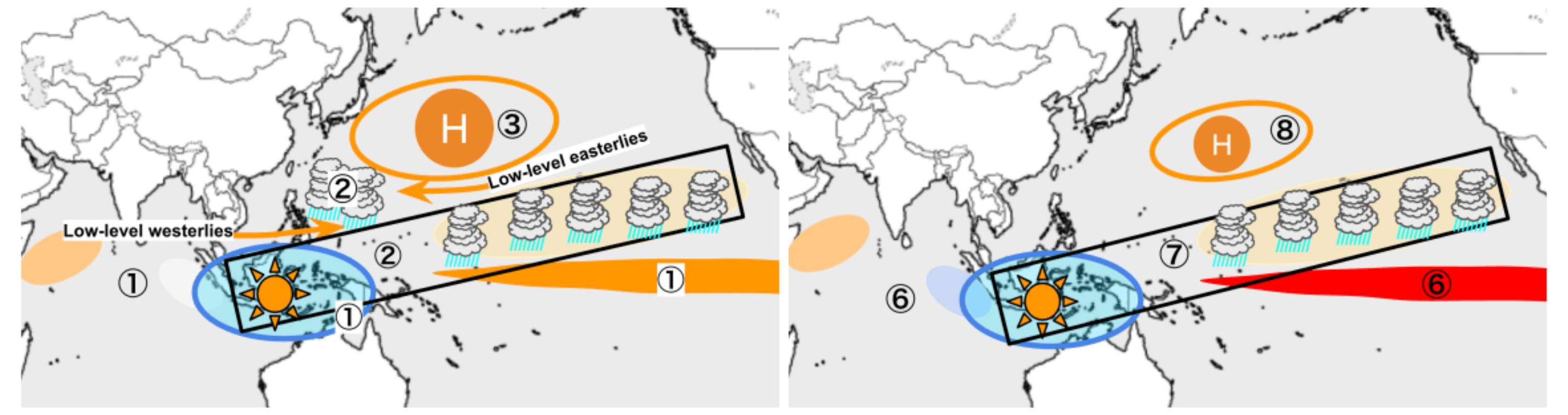
Tropical convective activity patterns for the first half (left) and latter half (right) of the 2026 season, showing the eastward shift in storm development conditions. (WNI Forecast Center, May 2026)
Typhoon Risk Areas
In June, typhoon risk is expected to be elevated primarily near the Nansei Islands. From July through September, the main risk zone extends northward from the Nansei Islands to western and eastern Japan. June and July are projected to see above-normal risk for Japan as a whole, while August shows elevated risk specifically in Eastern Japan.
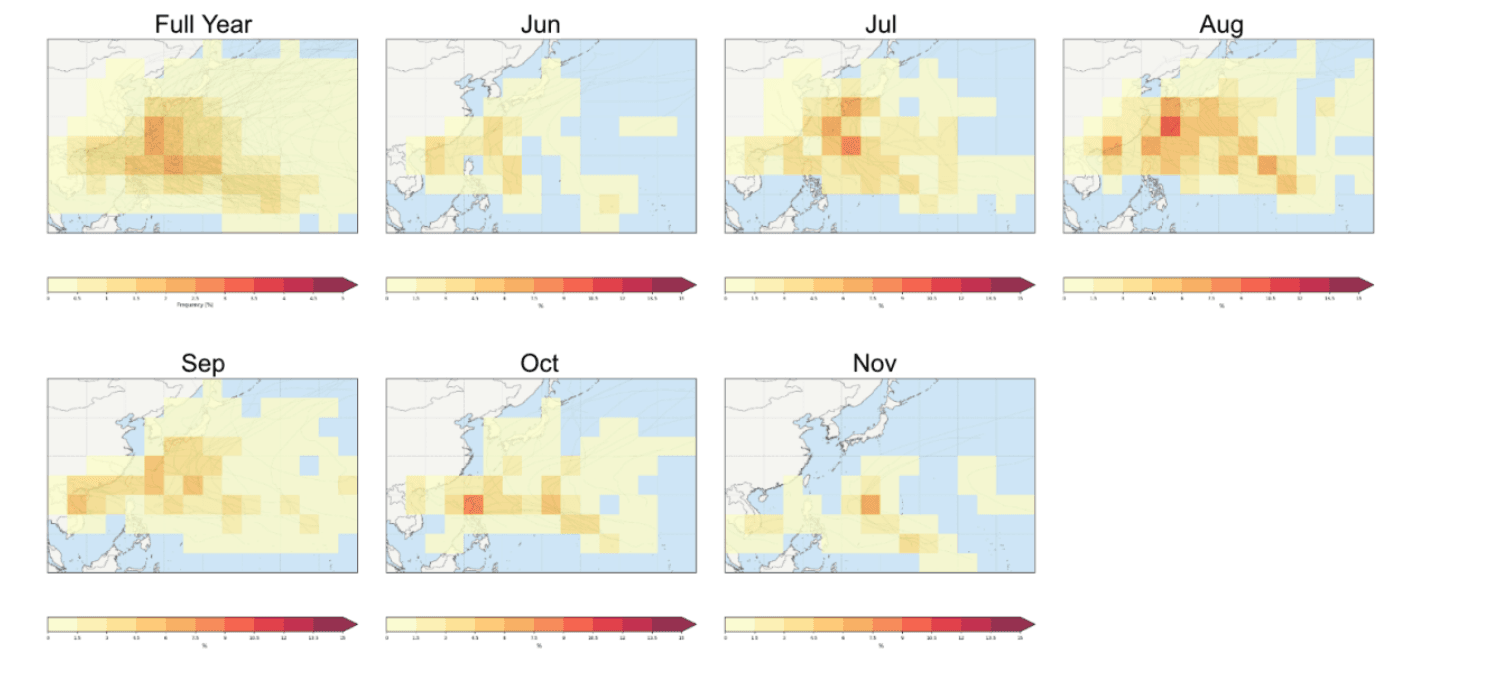
Northwest Pacific typhoon presence frequency — analog years, annual & monthly (Jun–Nov). Source: WNI, JMA Best Track Data
From September onward, risk areas are projected to shift further east than normal, with the area south to southeast of Honshu carrying above-normal risk relative to the climatological average. From October onward, activity is expected to concentrate in areas south of Japan and across the South China Sea.
Approach frequency for Honshu is forecast above normal in June and July, but below normal in September. Okinawa and Amami are expected to see near-normal approach counts, with the exception of a below-normal September.
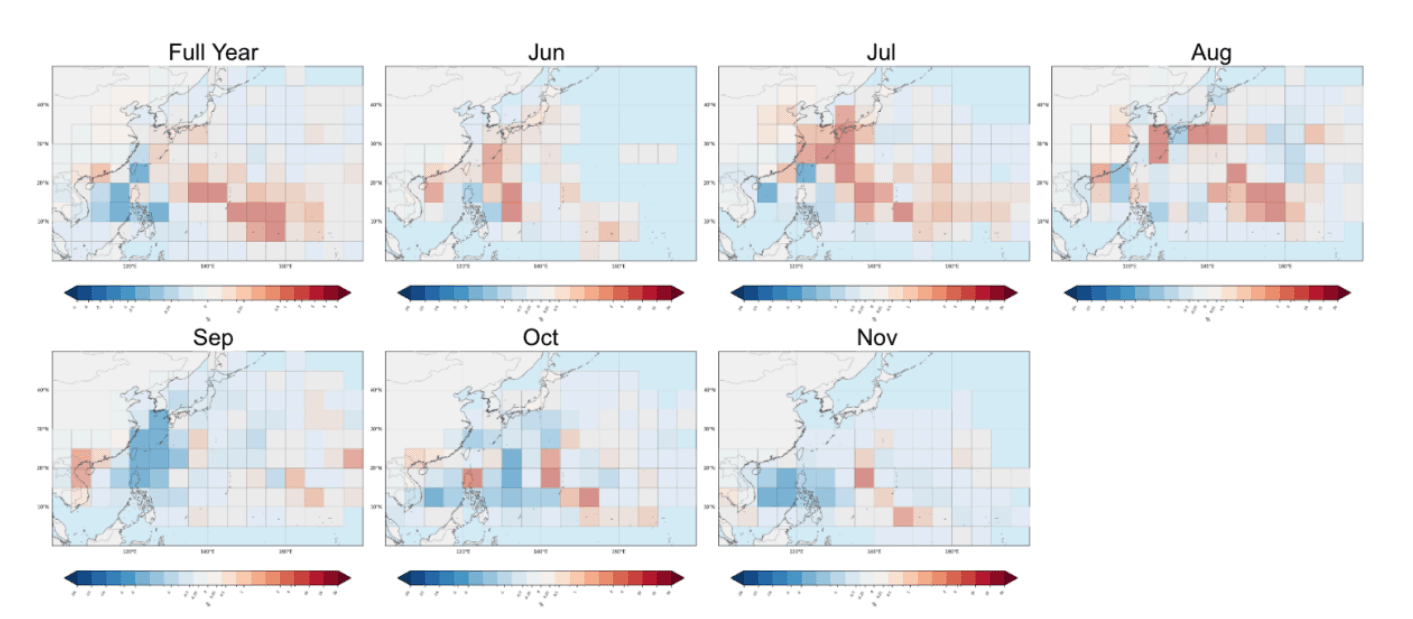
Northwest Pacific typhoon presence frequency anomalies — analog years vs. climatology, annual & monthly (Jun–Nov).Source: WNI, JMA Best Track Data
Typhoon Intensity
A significant feature of the 2026 season is the elevated risk of intense and long-lived typhoons, particularly during the latter half. According to TSR (University College London), the season's Accumulated Cyclone Energy (ACE) is forecast at approximately 410 — about 1.4 times the 1991–2020 normal of 301, and 1.6 times the past 10-year average of 250. ACE per typhoon is projected at 15.2, compared to the climatological normal of 11.8 and the 10-year average of 10.4.
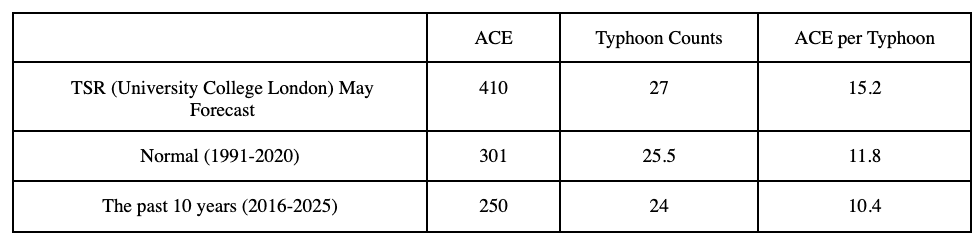
2026 Northwest Pacific seasonal intensity forecast: ACE, typhoon count and ACE per typhoon vs. climatological normal and past 10-year average. Source: TSR (University College London), May 2026
The mechanism behind this elevated intensity risk: during the latter half of the season, the westerly jet stream near Japan is forecast to flow further north than normal. As a result, typhoons tracking northward from well south of Japan may approach the region near peak intensity, largely unaffected by the weakening effect the westerlies typically impose. Typhoon HIGOS (2002; minimum pressure 930 hPa, maximum wind 50 m/s) and Typhoon JEBI (2018; minimum pressure 915 hPa, maximum wind 55 m/s) serve as reference cases for this track pattern.
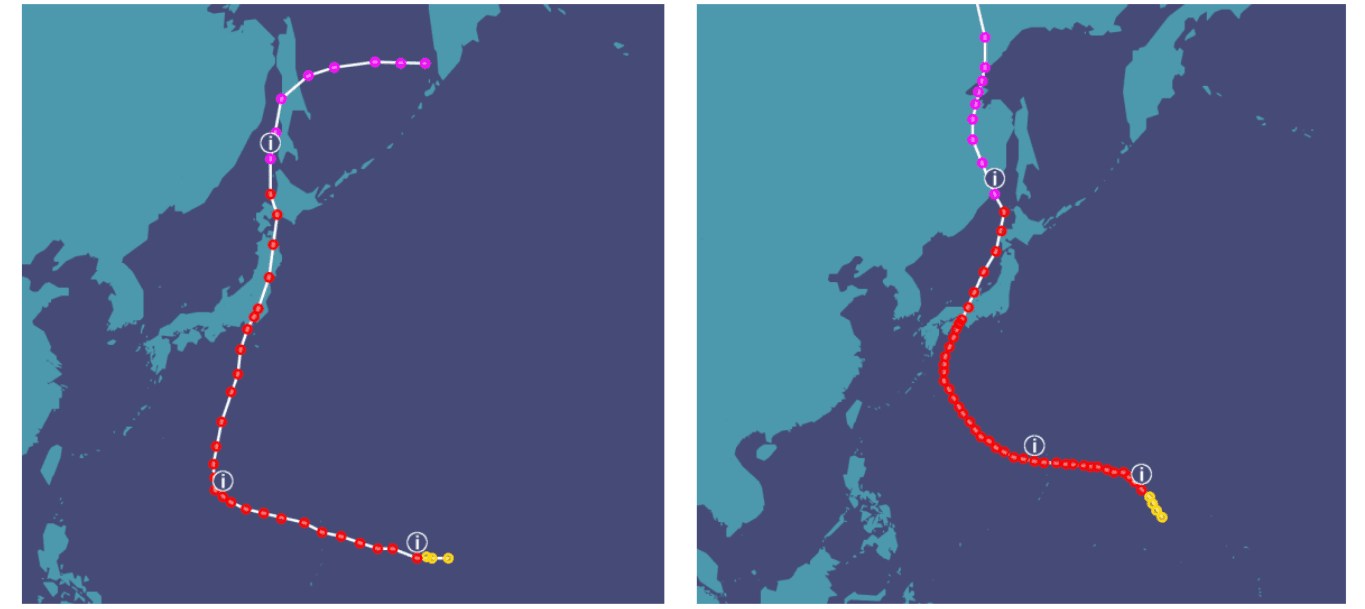
Reference typhoon tracks — Typhoon HIGOS (T0221, left) and Typhoon JEBI (T1821, right), illustrating the northward approach pattern toward Japan near peak intensity. Source: WNI, JMA Best Track Data
2. North Indian Ocean (Arabian Sea & Bay of Bengal)
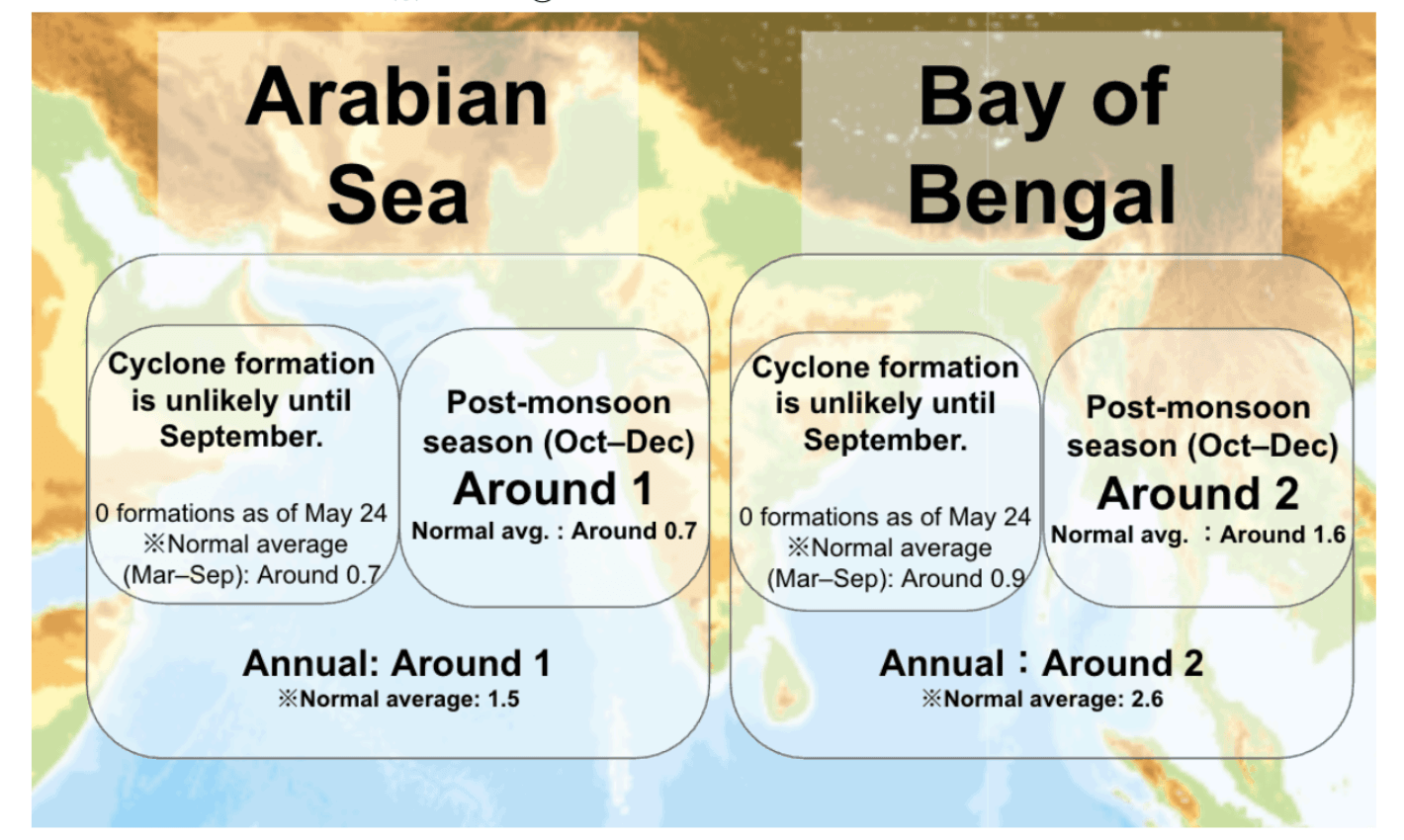
Comparison of 2026 North Indian Ocean cyclone formation outlook for the Arabian Sea and Bay of Bengal, including post-monsoon seasonal forecasts and annual totals versus climatological normals. Source: WNI Forecast Center, May 2026
Arabian Sea
Annual cyclone formations in the Arabian Sea are projected at approximately 1.8 — near normal relative to the climatological average of 1.5 (IMD). Formation activity is unlikely before October, with the post-monsoon period accounting for the majority of the season's activity. Formation locations are expected to favor the southern Arabian Sea.

Monthly Arabian Sea cyclone formation averages — analog years. Source: WNI, IMD
Bay of Bengal
Annual cyclone formations in the Bay of Bengal are projected at approximately 3.2 — near normal relative to the climatological average of 2.6 (IMD). The basin follows the characteristic bimodal pattern of the North Indian Ocean, with activity distributed across both the pre-monsoon and post-monsoon periods. Formation locations are expected to favor the southern Bay of Bengal.

Monthly Bay of Bengal cyclone formation averages — analog years. Source: WNI, IMD
Reference Years and Historical Patterns
This year's atmospheric setup closely resembles the seasons of 2023, 2018, 2015, 2009, 2002, and 1997, based on similarities in SST anomalies and atmospheric circulation patterns across the El Niño monitoring region and the Indian Ocean (NOAA).
In those similar years, Northwest Pacific and South China Sea typhoon formations ranged from 17 to 29, with an annual average of 24.8 — near normal. Monthly trends from these years show above-average June activity (similar years average: 2.5 vs. normal 1.7), near-normal July and August, and a moderated September (similar years average: 4.3 vs. normal 5.0).
In the North Indian Ocean, annual cyclone formations in the Arabian Sea averaged 1.8 across similar years, and Bay of Bengal formations averaged 3.2.
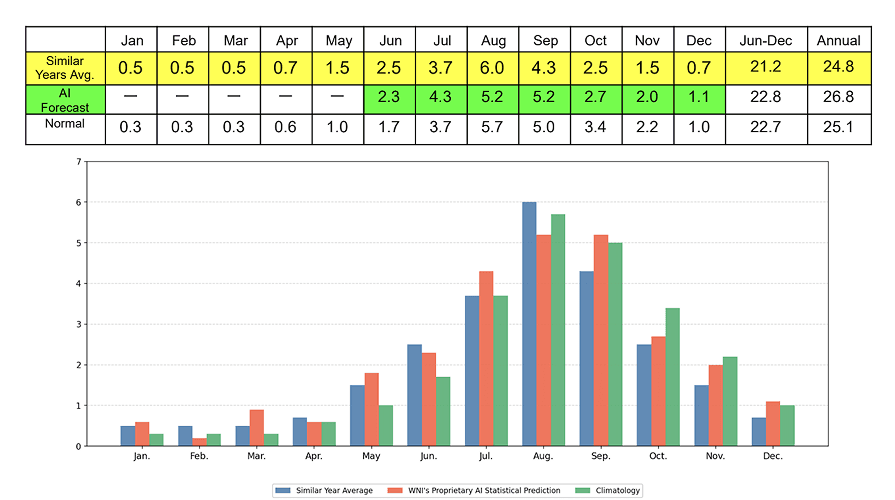
Monthly Northwest Pacific typhoon formation forecast — analog years average, WNI AI statistical prediction, and climatology. Source: WNI Forecast Center, May 2026
How We Classify Seasonal Activity
Throughout this outlook, activity is described as below, near or above normal. These labels follow Weathernews' own classification, based on the total number of typhoons expected to form in the Northwest Pacific and South China Sea over the full season. The thresholds are defined as follows.

As the Southwest Monsoon sets in, Weathernews is publishing weekly and daily port forecast snapshots across the Indian Ocean and South Asia for a limited time, free via SeaNavigator Free. See this week's forecast
Looking for another basin? Read our 2026 outlook for the Atlantic & East Pacific →