


It has been six months since the Strait of Hormuz closure disrupted one of the world's most critical energy corridors. For shipowners and charterers, the operational consequences were felt almost immediately: rerouted tankers, extended voyages, and a scramble to secure alternative cargoes. For everyone else, the effects have taken longer to surface. But they're arriving now, and they're showing up somewhere unexpected: the supermarket shelf.
In Japan, September will see price increases on 4,923 food and beverage items — the highest monthly total this year, and the first time since April 2025 that a single month has crossed the 4,000-item threshold, according to Teikoku Databank. One driver behind this wave is the continued rise in crude oil and naphtha prices, a knock-on effect of the shipping disruptions that followed the Hormuz crisis. And Japan is far from alone — as we'll see, the same underlying pressure is playing out, in different forms, across South Korea, China, and India.
The Strait Is Open. The Traffic Isn't Back.
Here's the part that surprises people outside the industry: Hormuz was never fully closed. Ships are still transiting. But "still open" and "business as usual" are very different things.
Weathernews' AIS (Automatic Identification System, source: Marine Traffic by Kpler) data tells the story clearly. In August 2026, only 96 vessels transited the strait — compared to 2,165 in the same month a year earlier. That's a 95.6% drop in traffic. Meanwhile, as of August 17, more than 1,000 vessels were anchored or waiting in the Persian Gulf, holding position rather than committing to the passage.
For shipping professionals, this isn't just about whether the strait is passable on a given day. Owners and operators are weighing crew safety, arrival scheduling, and the ripple effect on the vessel's next voyage. When those variables don't line up favorably, Hormuz stops being a reliable route — even if it's technically navigable.
And waiting has its own cost. Vessels idling in waters above 30°C face accelerated hull fouling — barnacle growth that increases drag, slows speed, and raises fuel consumption. The IMO has noted that heavy fouling can worsen fuel efficiency by as much as 40%. Diverting toward the Red Sea isn't a clean alternative either, given its own mix of security risk and weather exposure. Every operator is now making a case-by-case call: take the shorter, riskier route, or burn extra time and fuel rounding the Cape of Good Hope.
Asia's Quiet Pivot Away From the Middle East — Uneven, and at Different Speeds
Faced with a less reliable route, Asia's major oil importers have all moved to diversify sourcing over the past year. But they didn't all move at the same speed, or for the same reasons. That variation tells its own story.
Middle East Share of Crude Oil Imports — Major Asian Importers
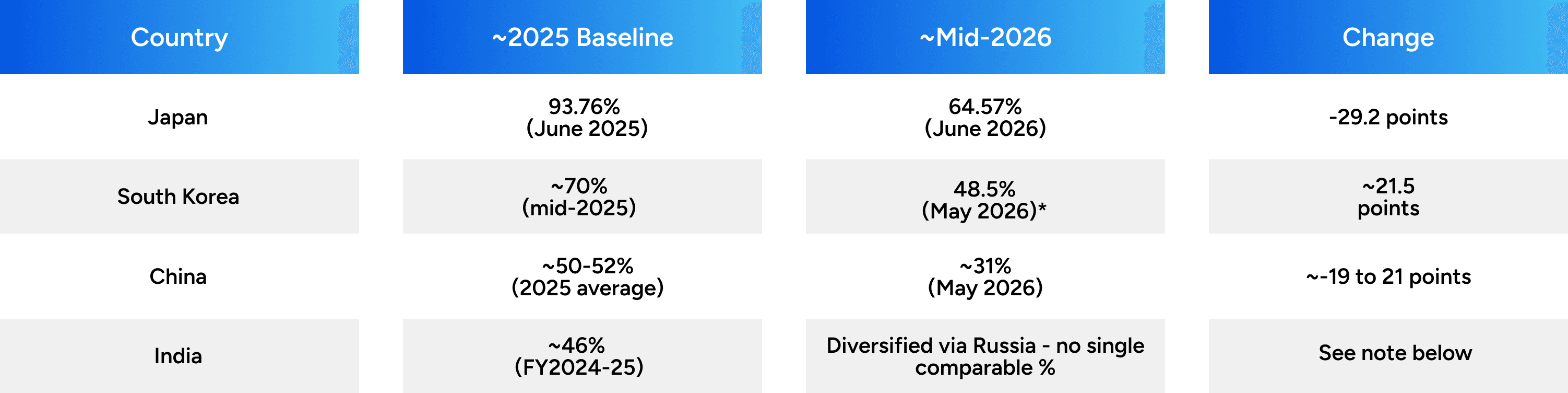
*Korea's H1 2026 average was 62.3%; the May 2026 figure alone was 48.5% — both are directionally consistent but reflect different time windows.
*Figures are compiled from national customs and government sources plus reputable financial media (Reuters, S&P Global, EIA), not a single standardized dataset. "Middle East" definitions and reporting periods vary slightly by country. India's 2026 shift is presented narratively rather than as a single percentage: dependency briefly rose to 55% in January 2026 before falling sharply as Russian crude exceeded 50% of total imports by June 2026 — a shift driven primarily by expanded Russian sourcing rather than a straightforward Middle East pullback.
Japan's case is the most granular. Ministry of Finance data shows naphtha-related sourcing moved the furthest — from 54.81% Middle East dependency in June 2025 to just 14.81% by June 2026, a 40-point drop. Crude oil moved more slowly: even after a 29-point decline, roughly two-thirds of Japan's crude imports are still Middle East-sourced. Naphtha buyers, it turns out, had more flexibility to switch suppliers quickly than crude buyers did.
South Korea shows the sharpest headline decline of the group (over 20 percentage points) with the slack picked up largely by the Americas, whose share of Korean crude imports jumped from 23.1% to 35.6% over the same period.
China's shift, while large in percentage-point terms, came with a twist: Chinese customs data doesn't report Iranian crude at all, so the "official" 31% figure likely understates China's true Middle East-linked exposure once unreported flows are factored in.
India is the outlier — not because it didn't change, but because its 2026 story isn't really about the Middle East at all. India entered the crisis already heavily diversified toward Russian crude, and the 2026 disruption simply accelerated that existing trend rather than starting a new one.
The takeaway: this isn't a uniform "flight from the Middle East." It's four countries making different trade-offs at different speeds, based on how flexible their existing supply contracts, refinery configurations, and geopolitical relationships allowed them to be.
Why Diversification Doesn't Mean Escape
Here's the structural reality that no amount of country-level diversification fully solves:
Strait of Hormuz — Global Exposure Snapshot
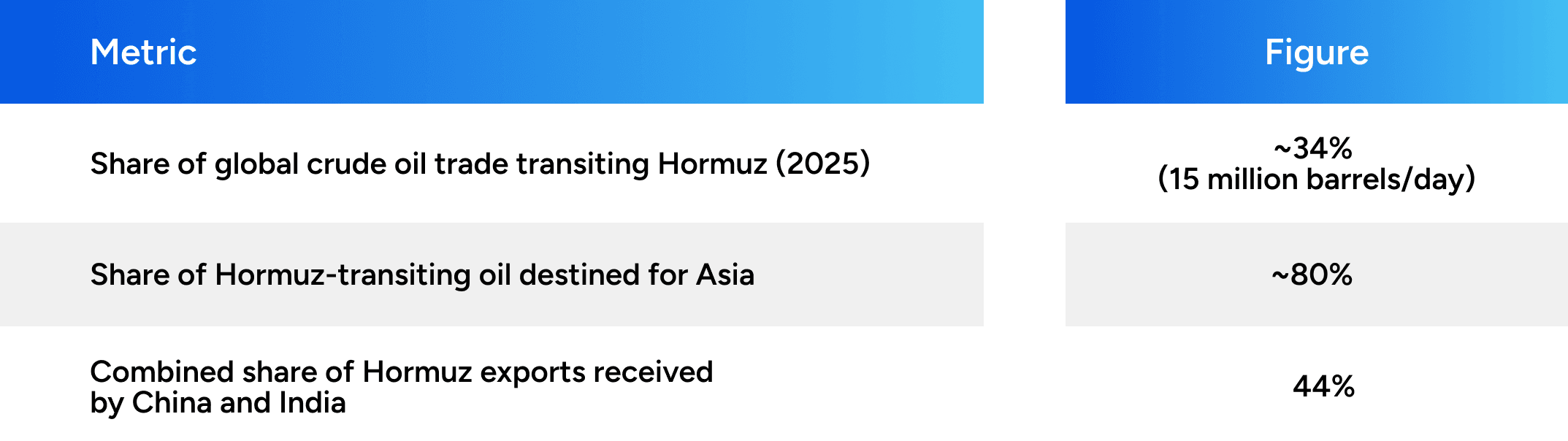
Source: IEA, adapted by author.
While countries have moved at different speeds to reduce direct Middle East sourcing, the chokepoint itself remains disproportionately an Asian problem: four-fifths of everything that passes through Hormuz is headed to Asian ports. Even South Korea, which cut its Middle East dependency by over 20 points, still moved roughly 68% of its pre-crisis crude imports through Hormuz specifically. Diversifying where you buy from doesn't fully insulate a country from disruption at the chokepoint itself, if the remaining volume still has to pass through it, or if the ships now carrying alternative-sourced cargo are competing for the same limited pool of available tankers.
Japan: The Cost of Turning to Alternatives
As the data shows, the global logistics system has grown to adapt to the disruption, but adaptation isn't free. Japan offers a clear example of how these costs have begun to appear.
1) Longer Routes = Higher Costs
Consider a large crude tanker moving from the US Gulf Coast to Japan via the Cape of Good Hope instead of a Middle East route: a voyage that would normally take 20–30 days can stretch to 45–60 days. That's not a minor scheduling adjustment. It directly reduces how many round trips a vessel can complete annually, tightening tonnage availability and pushing up freight rates across the board, not just on the specific routes avoiding Hormuz.
One documented case makes the scale concrete: a rerouted voyage that extended from 19 to 48 days saw fuel costs alone climb from roughly $1.26 million to $2.87 million for that single voyage.
2) Expensive Operational Workarounds
Rerouting isn't the only costly fix. Idemitsu Kosan, for example, continues sourcing Saudi crude while actively diversifying its shipping routes — a sign that even established supply relationships now require costlier logistics to maintain.
Ship-to-ship (STS) transfers — moving cargo between vessels at sea — are routine for crude oil, but far harder for LNG, which must stay near minus 162°C to remain liquid. That requires cryogenic equipment, tugboats, and specialized crews on both ships, and the process can take 30–35 hours. According to Bogdan Ratiu of LNG Synergy, most LNG STS transfers during the disruption have been emergency measures, not planned operations — and "it will easily add over $1 million if STS is involved."
The takeaway: the cost of navigating this disruption isn't confined to oil and naphtha. It's showing up across the energy trade.
3) Rising Energy Import Prices
The Japanese government's response is itself telling. On August 26, it introduced a subsidy program specifically covering the additional transport costs associated with sourcing crude oil and naphtha through non-Hormuz routes. A policy support scheme built around "extra shipping costs" is a fairly direct acknowledgment that the current system runs on risk-avoidance costs and detour costs, not a return to pre-crisis efficiency.
The price data backs this up. Since April 2026, Japan's energy import prices have spiked sharply.
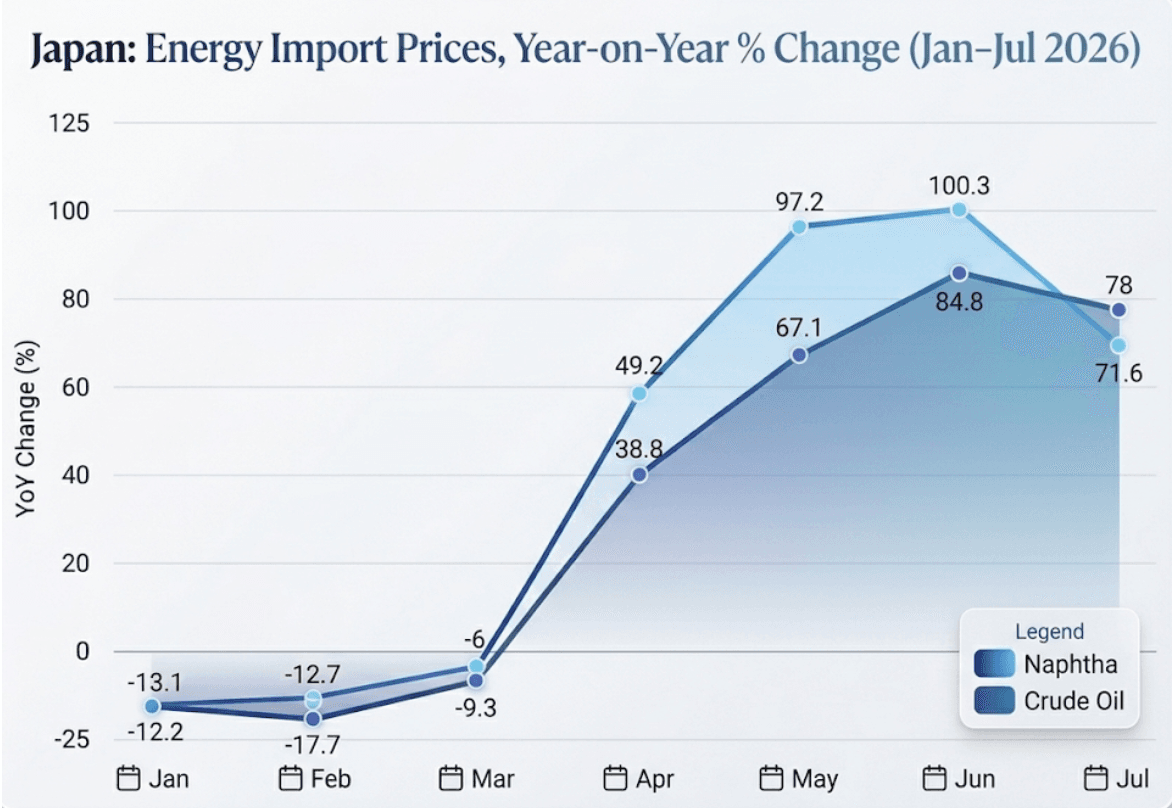
Crude oil: CIF price based on Ministry of Finance trade statistics, as published by the National Petroleum Dealers Association.
Naphtha: CIF price for petrochemical-use naphtha based on Ministry of Finance trade statistics, as published in the NAP REPORT.
Data adapted by author.
Energy import prices were flat or even declining year-on-year through the first quarter of 2026, but once the Hormuz disruption took hold, both crude oil and naphtha prices spiked sharply, peaking near or above 100% year-on-year by mid-year before easing slightly into July.
From the Wheelhouse to the Kitchen Table
So how does a strait transit problem end up on a grocery receipt?
It starts with the simple reality that cost spikes at the source inevitably flow downstream.
Take Japan's surge in energy import prices as a primary example. When imported inputs rise sharply, the knock-on effects affect everything those resources power or create.
Naphtha is a base input for plastics — food trays, bottles, packaging. Crude oil fuels the trucks, ships, and factories behind nearly every product's supply chain. When both rise sharply in cost, that pressure builds at every link: raw material procurement, manufacturing energy, and transport. Companies can absorb some of this temporarily, but not indefinitely — and the pass-through to consumer prices tends to arrive with a lag, which is part of why the effects are only becoming visible in food pricing now, months after the initial disruption.
And while Hormuz is choking oil supplies, it isn't just an energy bottleneck. Other critical items, such as the inputs that actually grow our food, have also been restrained by the crisis. Roughly a third of the world's seaborne fertilizer trade passes through Hormuz. Disrupted routing and higher freight costs there feed into global fertilizer prices, which in turn affect farming input costs — another slow-moving contributor to food prices down the line. Fuel-intensive fishing operations, particularly long-distance and offshore fleets, are also feeling the squeeze; some vessels are already shortening voyages specifically to conserve fuel, a trend that could eventually affect seafood supply and pricing as well.
The Bottom Line
Global supply chains have, in a technical sense, "solved" the Hormuz disruption: cargo is still moving, alternative sourcing is in place, and outright shortages have largely been avoided. But that solution comes wrapped in longer voyages, more complex routing, and higher fuel and insurance costs. And as the country-level data shows, "solved" looks different everywhere: Japan and Korea have made deep cuts to Middle East dependency; China's official numbers likely understate its remaining exposure; India's diversification predates the crisis entirely.
What ties all four together is the chokepoint itself.
Six months on, the operational overhead of avoiding (or simply navigating) Hormuz is no longer confined to shipping schedules and freight markets. It's showing up in food price lists this autumn, from Tokyo to wherever the next price increase lands. A reminder that developments in a strait thousands of kilometers away don't stay contained to the maritime sector for long.