

It has been a challenging year for shipping, with chokepoints and waterways around the world facing disruption. Earlier this year, we looked at how shipping traffic was affected around Hormuz and Bab el-Mandeb, and at the Northern Sea Route as one of the alternative routes being considered. Now attention is turning to the Black Sea, which the Financial Times recently called the world's deadliest shipping route.
The FT reported in late October that more than 570 vessels had been struck in the Black Sea this year, with dozens of seafarer fatalities reported, according to the International Maritime Organization. Behind the headlines, shipping activity in the Black Sea has also changed. In this article, we look at what the sea normally carries, how traffic has shifted this year, and what the winter weather ahead adds on top.
Where is the Black Sea?
The Black Sea is bordered by Ukraine, Russia, Georgia, Türkiye, Bulgaria and Romania, and reaches the Mediterranean only through the Bosphorus and the Dardanelles. To consider how shipping in the region has been affected, grain offers a clear example.
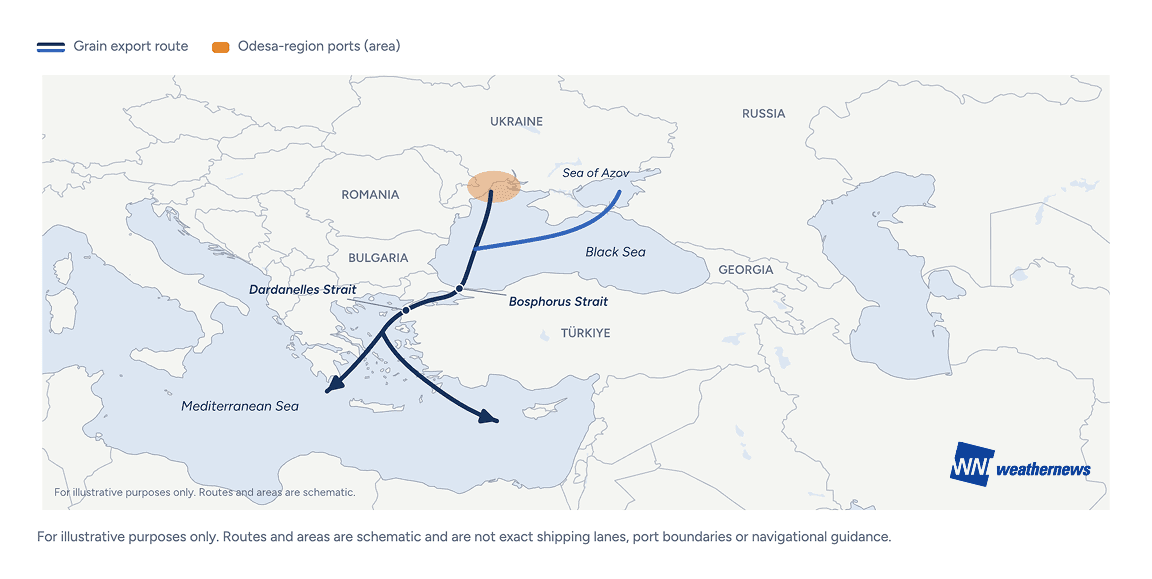
Black Sea Grain Export Route: Indicative route through the Bosphorus and Dardanelles. For illustrative purposes only. (Source: Weathernews Inc.)
For Ukraine and Russia alike, the Black Sea is the main grain export route. According to an article by the Council on Foreign Relations, ninety percent of Ukraine's grain and oilseeds normally flow through three ports—Odesa, Chornomorsk, and Pivdennyi. And a similar percentage of Russia's seaborne ceral and oilseed exports transit the Azov-Black Sea basin. However, much of that capacity is now idle or damaged on both sides.
Bulk carriers move dry cargo such as grain, so their movements are a useful indicator of how this trade is faring. Weathernews' AIS data show how their traffic has changed. Through most of 2025, roughly 360 to 470 bulk carriers were active in the Black Sea each month.
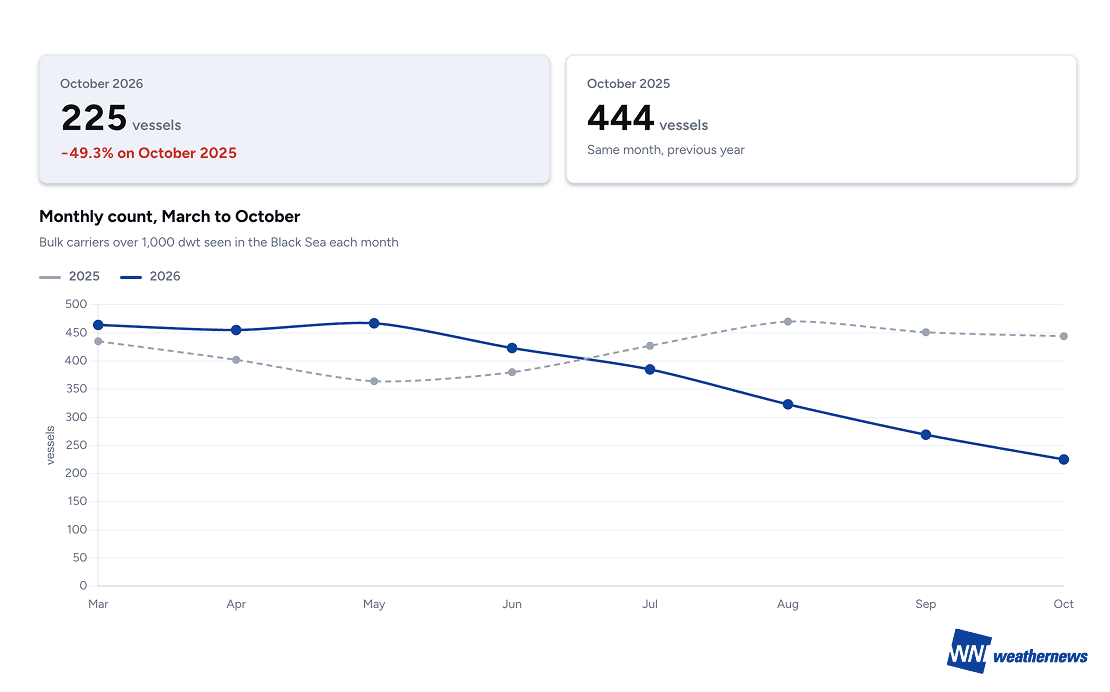
Bulk carriers over 1,000 dwt seen in the Black Sea each month, March to October 2025 and 2026. Vessels seen only around the Bosphorus and Marmara are excluded. (Source: Weathernews Inc. AIS data from Kpler.)
2026 has broken that pattern. Bulk carrier traffic ran above the same months of 2025 through June, peaking at 467 vessels in May. However from July it fell below the previous year each month: 10% lower in July, 31% in August, 40% in September and 49% in October, when 225 bulk carriers were active, against 444 in October 2025.
What Winter Brings to the Black Sea
From November to March, the Black Sea faces a different set of conditions from the rest of the year. For operators, four hazards are worth planning around:
- Storms and strong winds: Low-pressure systems cross the basin repeatedly and bring strong winds and rough seas, which are strongest from November to March.
- Cold outbreaks: Cold air pushing south can bring sudden northeasterly winds. The best known is the bora at Novorossiysk, which can reach gale force or stronger with little warning.
- Fog: Fog, along with strong winds, can pause transits through the Bosphorus and the Turkish Straits, causing queues at anchorage.
- Ice: In cold winters, sea ice can form in the Sea of Azov and in northern coastal waters, and cold, windy spells can bring icing on vessels.
Operators transiting the Black Sea this winter should allow extra time for weather-related delays, particularly around the Bosphorus and Novorossiysk, and keep a close watch on forecasts for wind, fog and icing along their route.
Outlook
Whether Black Sea traffic stabilises or keeps falling through the winter remains an open question. However, as chokepoints around the world continue to strain under geopolitical pressure, the weather is the one variable that does not change with the news cycle. In difficult circumstances, Weathernews will keep doing its best to provide mariners with reliable weather information wherever they sail.